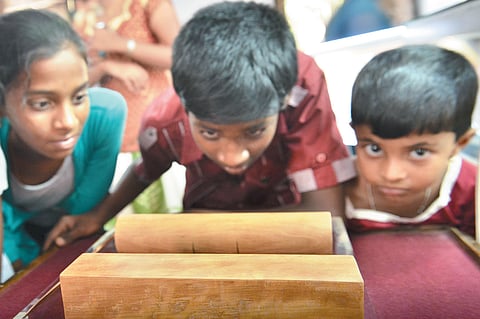

India has a rich history of using sandalwood for a variety of purposes for more than 2000 years. Throwing light on the age-old history, the Government Museum here has put on display chiselled sandalwood pieces as part of its ‘Exhibit of the Week’ series.
The exhibit aims to help students and children understand the uses of sandal, its eminence, as santalum album or Indian sandalwood is a threatened species.
An ornamental knife made out of sandalwood is among the exhibit. The sandalwood pieces were procured in 1951 from the then ‘Sandalwood Oil Factory,’ in Mysore.
M N Pushpa, curator, Botany section of the museum, said the display would help young learners understand the importance of sandalwood much beyond its commonly understood quality of fragrance.
Sandalwood has significant medicinal properties. It has a special place in Indian systems of medicine like Ayurveda. “For long, in India, sandal paste is applied to protect the skin. It has effective antiseptic properties that are very beneficial in healing disorders relating to urinary problems,” she said.
A pamphlet issued on the exhibit by the museum highlighted that sandal’s main component beta-santalol had antimicrobial properties.
Sandalwood paste is used to heal rashes and prickly skin. Even the Chinese herbal medicine practitioners use sandalwood to alleviate chest and abdominal pain. In China, sandalwood has been used as a remedy for various disorders since 500 AD. Sandalwood along with agar wood is the most commonly used incense material by the Chinese and Japanese in worship and in various ceremonies. It is used to make ornamental knife. Also, it is used in aromatherapy and in soaps. In India, sandalwood paste is integral to rituals and ceremonies to mark religious utensils and to decorate deities in Hinduism.
For thousands of years, sandalwood is often burnt as incense.
The exhibit is in keeping with the goal of the Botany section to show how plant life helps the humankind and other living organisms in myriad ways.