
Ever wondered what that tasty looking Panipoori laid out in front of you would mean in terms of calories or how much weight you might lose if you sacrificed a masala dosa?
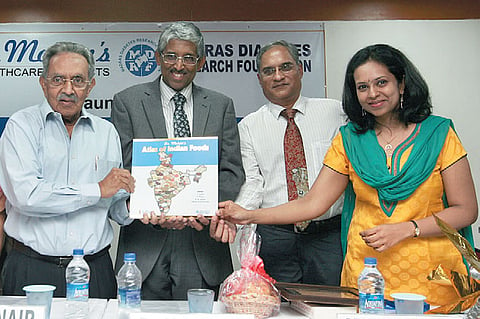
Well, all you need would be a ‘Dr Mohan’s Atlas of Indian foods’. The book, a result of seven years of research and analysis, is the first of its kind published on Indian food.
It provides a pictorial guide to 200 popular cooked foods from various parts of the country with details including calories, nutrients, fibre content and so on.
In an attempt to standardise the size or quantity of the food, each dish has been analysed for nutrients based on the size, which has corresponding pictures. So you will find out that a small dosa has a calorie content of 100 calories, while for a bigger one it is 240. Similarly, variations according to the size of the portion tools, be it spoons, ladles, containers or small vessels, are provided separately.
Similarly, the food items are also classified based on indicators like urban, rural, home-made, commercial, etc. “Finding out the calorific value or nutrient value of cooked food is a positive nightmare now. Most of the details, if available at all, are restricted to uncooked food. Even in the case of food packets, what one finds is a calorific value for only a sample quantity and not for the whole packet itself. All of which means making healthy choices is often too difficult.”, said Dr R M Anjana, vice -president of the Madras Diabetes Research Foundation.
Dr Anura Kurpad, president of the Nutrition Society of India, said that the Atlas would be a great tool for doctors, researchers and social workers. “It will not only help doctors and physicians suggest healthy food choices, but also help us track the diet history of migrating populations. In the last 10 years, about 100 million people have migrated to various parts of the country and the migrant population is at a much greater risk of diabetes. In cases like this, the book will go a long way in finding out diet patterns and history to help facilitate treatments.”, said Dr Anura.
The 200 foods that were selected depending on popularity and usage were based on various epidemiological studies. “The selected foods were then brought to the lab and analysed for their nutrient value after careful research and standardisation,” said Dr Sudha Vasudevan, architect of Atlas. The doctor said that in the subsequent sections more elaborate atlases with indepth research on the North Eastern States and other stand alone parts of the country would be brought out.
