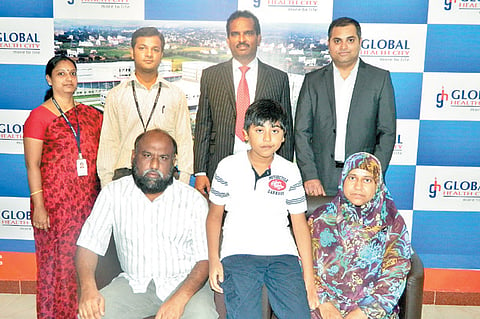

Niloy Haque had a very serious issue caused by a not-so-serious sounding medical condition. The eleven-year-old Bangladeshi kid was diagnosed with ‘conversion disorder’ and had been taken to several hospitals before they landed up at Global Health City.
Conversion disorder is a bizarre and rare condition which can strike down otherwise healthy young people, leaving them unable to walk or talk. It is a mystery and can baffle the doctors as physically the patients have nothing wrong with them. As a result the diagnosis is often missed out on.
“Everything seemed fine with him until a year ago”, said his emotional father. “Suddenly one day, he started having involuntary twitching body movements and started speaking to self. Things started to deteriorate, fast; he was unable to walk and complained of loss of sensation in his legs and arms”. A psychology assessment showed that he had “superior intelligence” but showed signs of stress factors. He lived in a large joint family and there were conflicts with his siblings, being teased by his cousins, overprotective mother and authoritative father. A car in which he was traveling to school met with an accident and it was badly damaged. That left him withdrawn for a few days after which the neurological symptoms developed.
Dr V Murugan, Paediatric Neurologist and Dr Vijayasaravanan Palanivel, Paediatric Neurodisability Specialist who first reviewed the boy said, “He appeared tense and anxious, didn’t want to make eye contact and spoke in a feeble voice. He was in his wheelchair and while we were speaking to his parents, he would suddenly start twitching.”
Explaining the condition, Dr Palanivel said, “It is a physical manifestation of psychological symptoms; the disorder is thought to be driven by a subconscious attempt to ‘convert’ strong, unbearable emotional thoughts or stressors in life into something more socially acceptable.”
His medication was gradually tapered off and his care was taken over by the Neurodisability Multidisciplinary Team (NMDT) headed by Dr Vijayasaravanan, consisting of physiotherapists, occupational therapists, psychologists, creative art therapists and yoga therapists. After two months of physical therapy, behavioral therapy, relaxation through dance and yoga, parental counseling and coping skills training, there was a dramatic improvement in his physical and mental abilities.
After 11 months of being wheel-chair bound, he was able to walk and run again and his parents were pleased that their son was “back to normal”.
