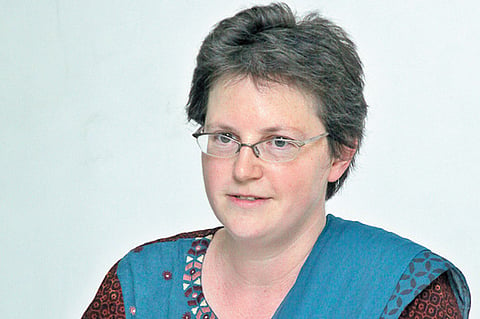

Female playback singing in South India began as a gender phenomenon, with deeply-embedded ideas in society about how the women artistes should look and sound, according to American anthropologist Amanda Weidman.
Weidman, who has been working on the project ‘Female voices in public sphere: cinema, playback singing and performance in Tamil in south India’ at the Madras Institute of Development Studies, for the last five years, said that her research of Tamil female playback singers of the 1950s and 60s was based on extensive interviews with the singers themselves, music directors and sound engineers among others. “I was trying to figure out playback singing in the State as a cultural phenomenon and not just as a technological process,” she said at an interaction here on Thursday.
Tracing the growth of playback singing in the Tamil film industry, the anthropologist, a faculty member of Bryn Mawr College in Pennsylvania, pointed out that in 1940s male singing stars were a phenomenon with M K Thyagaraja Bhagavathar, P U Chinnappa and T R Mahalingam reigning in the industry. “Films revolved around these stars with emphasis on keeping the integrity of their voices and body together,” she said.
The system of playback singing was referred to as Iraval kural (borrowed voice) and the idea of borrowing voices was viewed as cheapening the cinematic experience, said Weidman, who impressed the listeners with her fluent Tamil. “In fact, a magazine Gundoosi described it as Iraval vyabaram (trade in borrowed voices). There was concern over whether the then leading female star U R Jeevarathinam would jeopardize her acting career through her playback singing.”
It was only in the 1950s that there was a shift in how the system was viewed and the distrust was replaced with acknowledgment and celebration of the voices. The singing stars disappeared along with a shift in the kind of female voices that were being valued due to the influence of Lata Mangeshkar. “She emerged as an iconic figure and does not emote outwardly on the stage,” Weidman said.
With Lata Mangeshkar setting the standards, three singers – P Susheela, S Janaki and L R Easwari – rose to prominence in south India during the period and dominated the scene for several years. Analysing their careers, she said: “It is safe to say that those who made it big like these singers had been introduced by their parent or husband and were trying to fulfil the wishes of the male members of their family.” However, there were exceptions like L R Easwari.
Focusing on attaining voice recognition, they cultivated a particular appearance on stage. If Susheela was praised for her voice consistency, Janaki was versatile but appeared still on the stage. “I never forget who I am,” the scholar quoted her as saying.
The singer felt that to do justice to the character and song, it is not necessary to emote visibly. “Acting is all in the throat,” she felt.
But Easwari struck a different path through her husky voice, singing quick tempo and vampish songs. “Rise in the pitch of female voices was an important characteristic of the period that set off a debate in society,” she said.
