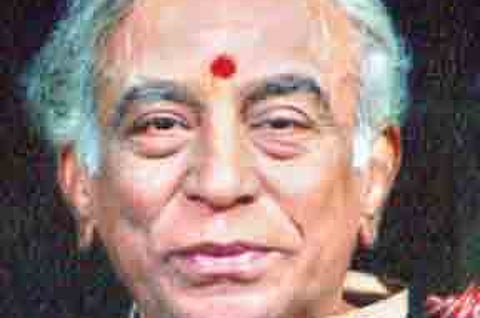

The recently released biography on Lalgudi Jayaraman—An Incurable Romantic by Lakshmi Devanath, published by Harper Collins, is certainly a delightful portrayal of the life and legacy of one of the brightest stars of the carnatic firmament in the past six decades.
We are aware that tradition with modern creativity and cultural underpinning and music with melody, were the hallmark of his music that struck a chord with his listeners.
The book narrates the social practices and beliefs of orthodox Brahmin families in the early part of last century. This includes Lalgudi’s father’s initial reservation, expressed to Palghat Mani Iyer against his son travelling abroad for the Edinburgh festival in September, 1965. This reminds one of a similar portrayal in Srinivasa Ramanujan’s biography—The Man Who Knew Infinity.
The chapter ‘Your music took me to the heavens’ is about Lalgudi’s selection for the Edinburgh music festival in September,1965. Yehudi Menon, impressed by a recording of Lalgudi’s music, recommended him to V K Narayana Menon, an Indian violinist and the then director general of the All India Radio. On his part, Narayana Menon selected K V Narayanaswamy as the vocalist and Palghat Mani Iyer for mridangam, and wrote to Mani Iyer, “The choice of the violinist is left to you. You can opt either for Lalgudi Jayaraman or T N Krishnan. Since Lalgudi’s name was mentioned first, Mani Iyer approached Lalgudi and coaxed his father to allow him to travel abroad. He assured him that Mani Iyer’s own son would also accompany them, as a second mridangam player. Lalgudi shyly tried on his first suit and also got a silk veshti, a silk jubba, and jacket over it that he described in his diary as a ‘Jawahar Jacket’. Palghat Mani Iyer refused any Western clothes, but was requested to take the over coat of Sadasivam. A grand function was organised at the Krishna Gana Saba to felicitate the artistes at which Rajaji said that the only thing that goes unadulterated from India is music and these are ambassadors of our music.
Their performance at the Edinburgh festival, and later at Royal Alabeert Hall, London and finally in Glasgow were scintillating and evoked great reviews, in the foreignPress. As Lalgudi promised before the tour started “Western audiences are going to listen to a music that is unfamiliar through an instrument that is familiar,” and he proved it. This concert paved the way for the life-long friendship between Lalgudi and Yehudi Menuhin.
GNB, the prince charming of the carnatic music world then, had Lalgudi accompanying him for the first time for a concert at Chetpet in February, 1949. Ten minutes into the concert, GNB delved into a stream of swaras, each pattern taking off and landing, at different points in the tala, with a view to evaluating Lalgudi’s skills. GNB relentlessly carried on this test with one song after another in a torrent, until he was satisfied that the youngster had the talent to respond. Lalgudi later remembered with nostalgia that had this session with GNB been recorded, it would have revealed, in how many different ways, he was tested by the maestro. GNB was never threatened by the skill of fellow artistes and was generous in his praise of his accompanists. No doubt he helped Lalgudi climb the heights that he had already reached, which was always remembered and acknowledged with gratitude by Lalgudi.
Though in the initial years, his relationship with Semmangudi, was not as good, over the time the friendship and mutual respect blossomed betwen the two. Given the unique repertoire of each, their combination electrified the concert halls, for decades. During the birth centenary celebrations of Semmangudi in 2008, Lalgudi donated the entire royalties of the Semmangudi-Lalgudi recordings, released on that occasion to the Semmangudi Trust, as a token of his tribute to the great master.
It has been said that music is enough for a life time, but a life time is never enough for music. In his last years, Lalgudi confirmed this adage when he said, “If god were to grant me a wish, I would say that I want to be made 25 years younger, so that I can delve deeper into the ocean of music.”
“My only sorrow, is that the final print of this wonderful book arrived a few days after my father’s demise, though my father had seen and approved of it, in its manuscript stage,” said Lalgudi Vijayalakshmi, with tears in her eyes.
