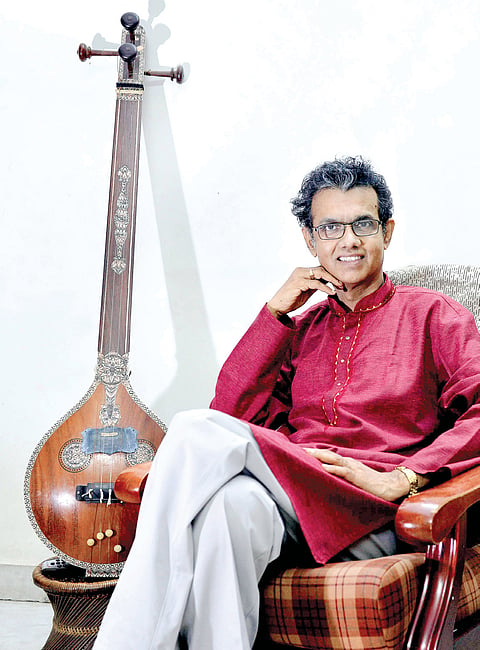

CHENNAI: He moved out of the performing circuit more than a decade ago after a career spanning several years. Moving to another terrain — composing for dance production — he began exploring a different side of music. Rajkumar Bharathi, the classical vocalist who endeared himself to the public with his rendition of Bharathiyar songs, apart from fusion concerts with Western musicians and jugalbandhis with Hindustani vocalists, is today the most sought after composer for dance productions.
A disciple of TV Gopalakrishnan and the great grandson of the celebrated Tamil poet Subramaniya Bharathi, Rajkumar was a popular name in classical music circuit till the early 2000s. A voice problem around the same time made him actively take up composing music for dance productions.
“I was contemplating my next move and a few of my friends suggested that I did compositions. But my first composition for a dance production was way back in 1992, for a live performance by Malathi Iyengar of Rangoli Fine Arts. Around the same time, dancer Rama Bharadwaj wanted me to work for her production on Panchatantra,” he adds.
It was a chance offer that changed the course of his career, but he believes that composing would have happened sooner or later. “The ability to compose was always there within me. And dance is not very different for a musician. The only difference is that it is a visual medium; there is another dimension and you have to give life to words with sound and visuals,” he says.
When he got back to composing music full-time, it didn’t take him much time to establish himself and he was flooded with offers.
He adds that today with a rise in the number of thematic presentations, tailor-made music for dance programmes has become the norm. “There is a research person with the dancer working on themes that are mythological, and off-beat. They are based on grammar, yet new. I was part of a production that was based on poems on moods, in different languages. Renowned danseuse Alarmel Valli wanted to perform with music and interspersing poetry, while another dancer Jayanthi Subramaniam adapted Jonathan Livingston Seagull, a novel by Richard Bach, in the dance format. The production was entirely music and narration in between, without lyrics. There is a rise in thematic productions year after year. Natyarangam has yearly shows based on themes; this year it was the Upanishads,” he says.
Working with artistes abroad, Rajkumar has been part of several large-scale productions. He recollects a performance that had around 150 dancers in Singapore. “It was the story of an Indian princess who visited the famous Angkor Wat Temple in Cambodia. The music was part live and part recorded, and had to match each other seamlessly. The recording was done at Resound India by recording engineer Sai Sravanam,” he says.
With his music career having transited seamlessly to composing full time, one has to ask, does he miss singing? “I don’t miss anything in life in general. When I had a problem with my voice, either I had to sit and sulk or move ahead. You can’t be in conflict with life,” he replies on a stoic note.
