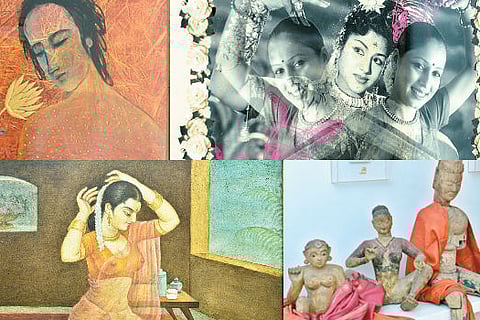

While royal saris, flower-adorned hair and gleaming jewellery reflect the status of courtesans in the medieval world, a stooped posture, veiled faces and sagging breasts are a stark representation of their disgraced position today.
The paintings at Apparao Galleries by Anjolie Ela Menon, K H Ara, Jayashree Burman, Laxma Goud, F N Souza, K G Subramanyam, Sunil Das, Bikash Bhattacharaya, Sophie Jo and Jatin Das, among others, bring alive the courtesans of the past, who celebrated beauty, sex and elegance.
Their works show how our present culture wouldn’t have been what it is today, without their contribution.
One of the paintings has a woman carelessly holding a lotus between her fingers. Eyes shut, she seems to be absorbing the floral scent. Her nude body is covered with golden spots, like an expensive mannequin. The simple painting captures her femininity, sexuality and sophistication — all in one frame. After all, wasn’t she a courtier who attended the court of monarchs?
Tawaifs, as they were called in Mughal India, had their counterparts in other parts of the world during the same period. There were Greek Hetairas and Japanese Geishas, who were also appointed as unofficial advisors to the king.
Apart from their role in the State affairs, courtesans were responsible for the patronage of dance and music, suggest the paintings at the show. One of the works shows them in the form of mermaids — each in different dance postures — with one of them holding a flute beside her beetroot-coloured lips.
It is said that Kanjaris, the courtesans of the North, helped propagate ghazals and dance forms like Kathak, and Devadasis (servants of god), as they were called in the South, kept alive bharatanatyam, odissi and kuchipudi.
As a contrast to their flourishing lifestyle, there are paintings which show them forlorn, with melancholic eyes and disdained looks.
A few convey their stupor with just a few strokes and others translate their tainted image in society with a disarrayed patch of colours. What made these women, of such intellectual stature, get dismissed as mere sex workers? It is said that with the advent of British rule, the Indian kings lost their wealth. The fall wiped out their royal patronage to art. The courtesans then became an unaccepted part of society.
Their sexuality, which was earlier embraced, became a blot in the name of womanhood. And, it remains so even today.
The Courtesan can be viewed at Apparao Galleries, No 7, Wallace Garden 3rd St, Thousand Lights West, Nungambakkam. Phone:044 2833 2226.Hours: 11 am to 7 pm, till April 5.