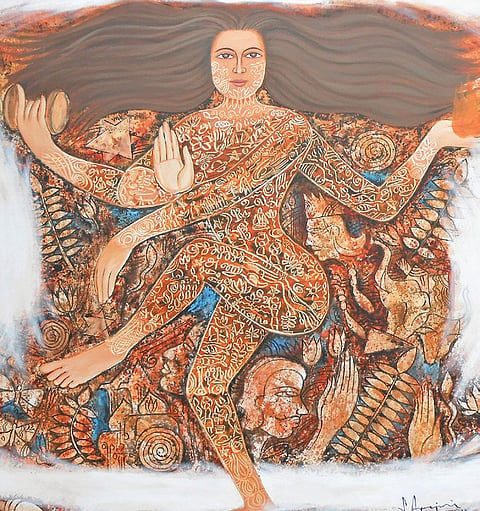

There is a strong connection between the smallest unit of matter, atom, and Nataraja, according to S Arunagiri, a contemporary artist. He explored the same in depth, and came out with the painting titled Atom, which shows Nataraja, complete with four hands, one foot raised, and the other resting firmly on the ground. The artwork won the artist a cash prize of `1 lakh and the title Emerging Artist 2015 from Prafulla Dahanukar Centre, Mumbai — a foundation established in memory of the late artist Prafulla Dhanukar, last year. “An atom, which is the base for solid, liquid, gas and plasma, when seen through a microscope, has the same shape as the dancing form of Nataraja,” says the artist, who has been in the field for the past three decades.

He adds, “The upper left hand holds jwala or flame, without which there can be no life. The upper right hand holds an hourglass drum or dumroo, the sound from which is believed to be the first sound of creation — that which made all the matter come alive.” In the Hindu religion, Nataraja represents the endless cycle of birth and death, and modern physics has shown that the rhythm of creation and destruction is also the very essence of any matter, adds Arunagiri.
According to Arunagiri, who has been researching on the subject from the time he was an art student, the Nataraja icon was developed as a bronze sculpture in South India in the 9th and 10th century, during the Chola period. It was later in the 19th century or so, artist Raja Ravi Verma, gave it a form with leopard skin and a Himalayan backdrop, just as it is widely accepted today, he says. “This is because it is believed that it is in Manasarovar, beyond Amarnath, that our souls rest. Hence the snow mountains in the backdrop of lord Siva,” he says.
Arunagiri, whose works are based on environmental issues, culture, humanity and human health care, says that he believes he has a responsibility to represent issues affecting society, through art. — Naveena Vijayan