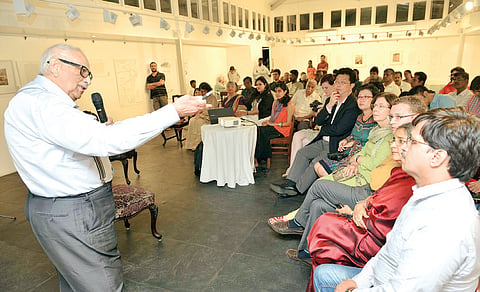

Did you know that it wasn’t the British but an Indian who first came up with the idea of connecting water bodies for trade? That idea is why the Buckingham Canal came into existence. The canal, for which construction began by 1801, is one of the city’s landmarks today, said D H Rao, who delivered a lecture on The City by the Canal at Amethyst recently.
Delving into history and sharing his own experiences, the speaker said he travelled 420 kilometres by boat on the canal, in 2009. He made the trip again this year. “The first step was from Pulicat and from there, the real journey began. When I reached Peddaganjam, the locks were vandalised. Once up on a time, the canal used to be beautiful, and was used to bring firewood and vegetables by boat to the city,” said Rao.
“Also, when I visited the Sardas lock in Adyar, one was missing. Two-sided concrete walls were being built and one must have been pulled down. I couldn’t read the date on the lock because we were unable to get any closer,” he said.
Beginning with the history of the Buckingham canal, he explained how and why the process started and then gave details of the construction. Small anecdotes on each canal accentuated his narration.
For instance, till 1876, there was no link between the Cooum and Adyar rivers. Lord Buckingham, the then governor, ordered that a link canal be dug as part of relief work during a famine. Throughout his lecture, he used pictures to make the audience understand history better. He also showed pictures of how a canal looked then and pictures of the pathetic state they are in now.
Rao completed his second journey on January 15 this year. “I reached Peddaganjam canal on the day of the festival, Pongal, and the time was 5.30.We were racing against time as I wanted to finish the journey before sunset. And the scenery at that time was breathtaking,” he said and showed a picture shot then.
Some historical landmarks, have over time, served other purposes too. For instance, the canal, which extends from Sholinganallur to the backwaters of Muttukadu, has clean water and students from a Marine Engineering college now take rowing lessons there.
By the end of the lecture, an entire chapter of our city’s history was rediscovered by plenty of people gathered there. Rao also mentioned that his journey had taken a turn to the lighthouses of India, where he discovered history pieces by interacting with the lighthouse keepers there.
