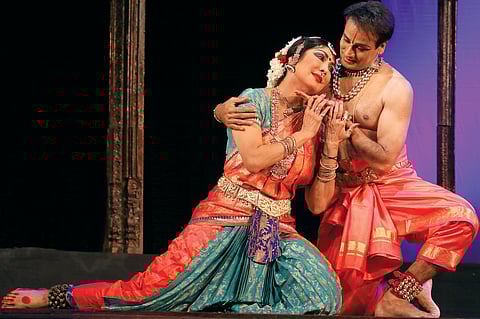

Noted dancer Vani Ganapathy’s foray into the world of bharathanatyam began when she was just four. Certainly, she has grown over the years with the able support of her mother Indubala on vocals and training by guru Kalyana Sundaram Pillai.

When this gifted dancer, a globetrotter, presented her ingenious production ‘Dwaaram’, an the autobiography of the door in the company of dancer Satyanarayana Raju, in bharathanatyam format recently at Narada Gana Sabha, her presentation outlined that life was a series of pathways as the saying goes, ‘If one door shuts another opens’.
This well-conceived production showcased the door as the narrator with each of the doors speaking about feelings and emotions. The tales, the experiences and the memories that they have witnessed were depicted in this presentation through the doors of a palace, a fortress, a house, the temple door and the door of the soul.
‘Dwaaram’, which is about tales of passion, was a medley of tales and episodes.
Through the eyes and ears of the ubiquitous doors, besides weaving in aspects of mythology and history, the entire production mesmerised the audience.
The production began with the raja dwaaram (main gate of a palace), narrating the story of Draupadi’s vow of leaving her hair long unplaited until her husbands avenged the Kauravas for the humiliation meted out to her. Then, hopping on to the veera dwaaram (the gate for the valiant), encapsulating the bravery of Narasaraja of the Wodeyar dynasty, the dancer Satyanarayana Raju with his powerful performance kept the audience spellbound.
Later, the portrayal of the gruha dwaaram (the gate of an ordinary house), was made in the form of a padam, showcasing the fact that a house door remains a spectator and mute witness to love-hate relationship between human beings.
And then the dancers moved on to depict the deiva dwaaram (the gate of the divine) that existed between Lord Vishnu and Andal through impeccable movements.
The last one was the atma dwaaram, (the gate of the soul), which took the audiences to transcendental state that showed how human beings conquer the six vices of kaama (lust) krodha (anger), lobha (miserliness), moha (infatuation) madha (arrogance) and matsarya (jealousy)
The standing ovation was certainly an indicator of the success of the presentation. This production ‘Dwaaram’ stands to the credit of Vani and Satyanarayana, a senior dancer and disciple of the late Narmada.
A word of praise to the vocalist and composer Shri Srivatsa and his vocal effusions that gave us a live ensemble music and designed lighting, showcasing the door way to creativity of the dancers.