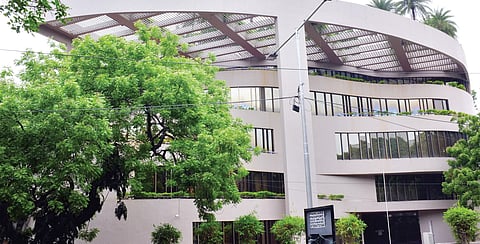

CHENNAI:The corporate headquarters of MRF on Greams Road and Sundaram Finance on Whites Road in Chennai, and most recently the Mahindra Research Valley in Chengalpattu, reveal the signature touch of master architect Charles Correa. It was about the magnificent open skies that elevate the beauty of concrete structures by blending them with the nature almost seamlessly.

Correa, a Padma Bhushan and Padma Sri awardee, passed away in Mumbai at the age of 84 on Wednesday.
“He was a regular to Chennai, especially after he designed the MRF building on Greams Road. His approach to design was contextual. He once told me that MRF building’s curve was inspired by the natural curve of the road it was located in. There should be a memorial library in his name with books detailing every one of his works,” said CR Raju, chairman, Indian Institute of Architects (TN chapter).
In the years after Independence, for a country that architecturally was on the crossroads between the opulent Indo-Saracenic designs of the Raj and the ultra-utility concrete monoliths, the Goan offered the middle path of beautiful public structures. Over the years, he moulded urban design in India with works including Navi Mumbai, the extension of the metro city, the Mahatma Gandhi Memorial at the Sabarmati Ashram, Jawahar Kala Kendra in Jaipur, National Crafts Museum in Delhi and the legislative assembly of Madhya Pradesh.
Impressed by Correa’s designs, he was also commissioned to design projects including McGovern Institute for Brain Research within Massachusetts Institute of Technology, United States, Champalimaud Centre for The Unknown in Lisbon, Portugal, and Ismaili Centre in Toronto.
“Charles Correa was, is and will be the only role model for Indian architects. In fact, there is a chapter in the academic curriculum of architecture students where they are taught Indian architecture and Correa’s name and works prominently figure in it,” said Xavier Benedict, Anameka Architects and Designers.
“If you look at the Mahindra Valley, there is so much natural light striking the courtyard. One also has to marvel at the vegetation,” he added, explaining the nuances of Correa’s design philosophy.
He Believed in the Cities of India
History, culture, the human mind, climate, public transport — these diverse elements were a part of Charles Correa’s architecture. In the introduction to his book ‘A Place in the Shade’, he writes, ‘you cannot look at cities without wandering into architecture on one hand and politics on the other. And you certainly can’t look at architecture without also encountering other areas as diverse as music and landscape and film and toy trains.’ And true to his word, the book begins with an essay on how toy trains were the reason he got into architecture — tinplate rails that went back into the box to emerge in a completely different form the next day.
Deeply interested in the magic of cities, he believed in the cities of India. “Like the wheat fields of Punjab, and the coalfields of Bihar, they are a crucial part of our nation’s wealth,” he wrote, and called them engines of economic growth and centres of hope, and believed in better integration of architecture, economics and public transport for the urban growth in India today.
Made for Madras
It is difficult to pass by the busy Greams Road without taking a glance at the MRF Headquarters, which was built in 1987, with the stepped terraces and the building that curves along the road. The building was designed to go with what was then the relaxed and quieter style of Madras and its low-rise skyline. The striking blue against white with shadows of the louvered roof of the Sundaram Finance Building on White’s Road is also another contribution of Correa to this city, and is considered an excellent example of playing with the form within a small site within municipal restrictions.
Common Man’s Connection with the Cosmic
Correa studied at MIT but his concepts were always rooted in India, and he always drew from the sacred — the gestures like the Yantra symbol, the rangolis. The Vaastu Purusha Mandala - a perfect square divided into nine parts- played a strong role in some of his designs such as the Jawahar Kala Kendra in Jaipur, and he did not want to let go of the common man’s connection with the cosmic.
Courtyards, shadows and human scale also played a valuable role in his buildings. The response to local climate and local needs were foremost on his mind, whether he was doing low-cost housing in Mumbai or resorts in Goa.
“Market forces do not make cities, they destroy them”
— Charles Correa