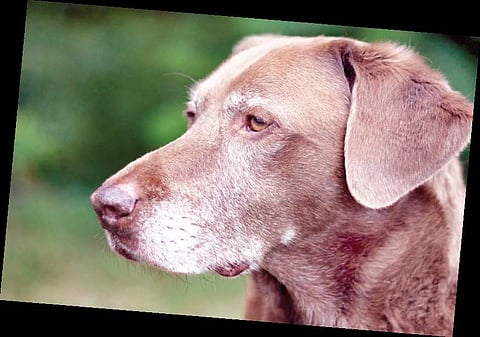

CHENNAI: Do not ignore an early greying of your dog’s coat. These could be indicative of nutrient deficiencies or chronic diseases.
Premature Greying
Premature greying refers to a condition in which your dog's coat begins to lose the richness of its natural colour and adopts a dull grey tone. The earliest sign is that your dog's hair will begin to get lighter in colour near the root, and the hair shaft itself will begin to thin out. This can be difficult to spot on a dog with a light-coloured coat.

Types of Greying
As far as greying is concerned, it is similar to humans in nature, says Dr Pavan Kumar from Cessna. “They also undergo greying. There are two types of greying - geriatric greying and premature greying. Geriatric greying is when they grey with age like humans. Premature greying is greying at the age of three or four years, while greying after eight years is normal.”
Causes
Though premature greying is not a disease, it could be a symptom of long-term stress, disease or nutrient deficiency. Dr Pavan explains, “The body is made of different cells. The pets could suffer from stress due to some chronic illness, infection which affects the skin and hair cells, leading to greying. Also, greying could be because of the environment and climate, he or she is living in. More humidity and exposure to sun could also be the problems.”
Hormonal changes are the third factor. Dr Pavan adds, “Melanocytes cells are very important. They are responsible for greying, that is dilution of skin colour. When the levels of melanin, a primary determinant of skin and hair, goes down in the body, due to health or climate issues or stress, it does produce chemicals leading to greying. Also, improper functioning of Thyroid hormones, pituitary gland and adrenalin can lead to dilution of colour.”
He adds that every one case of 20 cases, he receives, are of premature greying. It is more visible in the pets with darker coats. Breeds like poodles are more affected due to their genetic structures.
Early Breeding
Another veterinarian Dr Karthik M G adds that early breeding also leads to premature greying. “Usually breeding should be done after a year. The hormonal imbalance can lead to early greying. Use of steroids is also a problem. It is more common among the female dogs. More exposure to sunlight can also lead to early greying in muzzles and thigh region as the fat cells are more in these areas.”
TreatmentLack of vitamins and zinc lead to early greying, says Dr Lohith HD. “The pets need essential fatty acids. If they feed mostly on human food, they may lack a balanced diet. Other than genetic issues, early greying is usually due to thyroid as well. In case of low thyroid, we do blood tests and prescribe medications. Over a period, you may not see any grey hair as they usually shed them. Greying will stop but won’t turn to their normal skin colour.”
If it is a genetic problem, there is no treatment, says Dr Lohith adding, “The dogs do not respond to the treatment at all. I recently got a case of two-year-old rottweiler. He started developing patches. He is turning from dark to completely white. He’s turning grey. It is not detrimental to the dog’s health but can affect his appearance.”