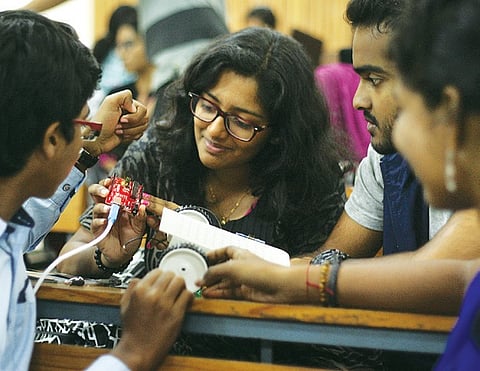

CHENNAI: Sparks flew as metal clashed with metal at IIT’s Shaastra’s Robo Wars. Mean machines powered by 3-4 car batteries raised a racket akin to a power generator and a mechanical workshop running in parallel. One could gauge the intensity by observing the robot controllers wearing two-wheeler helmets. “So that none of the parts fly out of the ring and hit them in the eye or something,” explained a participant.
“This is Optimus A, a wedge-bot. Several components for this have been imported from the US,” says third year Mechatronics student Manoj Kumar from Kongu Engineering College (KEC), Erode. “It costs about Rs 25,000-30,000, and takes about 15 days to a month to make,” says Manoj.

The participation from the Kongu belt has been strong — for this event alone, four teams from KEC participated; and it wasn’t limited to robo wars. “I have been into remote-controlled planes since I was in Class 3. Now I’ve graduated to hovercraft,” laughs Gowtham J, a Class 11 student from Mettupalayam. As he speaks passionately about thrust, Jairo receivers and how he learns from the Internet, one realises that access to the web is enabling youngsters anywhere and everywhere to fuel their passion. “I have built the body from plastic-based board. All are parts which you can easily get in hobby shops or online,” he says, adding that it took him three days to make.
Hovering around the hovercraft workshop, one learns it takes newbies 7-8 hours to make one (even if they have the background) and costs about Rs 8,000-9,000. Meanwhile at the eye robotics workshop, participants were making a robot which detects obstacles. “This concept is used in industrial bots. Now, they can even be controlled with your smartphone,” says Ashfaq, in charge of the workshop.
At the ‘humanoid’ event, students developed actual 1-2 foot tall robots that could walk around and kick a ball. These bots, which can walk on two mechanical legs are classified as ‘biped’. “The thing about these robots is that they can be coded to walk. A lot of robotic vehicles have wheels. But these bots — programmed using C language — can walk around on any kind of terrain,” says Rahul Kejriwal, one of the organisers of humanoid. It costs anywhere between Rs 1,000-1,500 to make a small one.
It was a day to enjoy the wind at IIT. But not so for aerial robotics participants, whose drones were being tossed about. However, braving the wind is something that the team from Sathyabama University in the city had factored in. “We chose the design such that it is small and stable. One of the parameters being tested is endurance,” says Ram, an aeronautical engineering student from Sathyabama.
It’s not just competitions that these college students are out to win. “After the floods, we have been developing a drone fitted with a video-camera that can carry a first aid kit and a coil of rope to people stranded in a disaster.”
Spiral Windmills
IIT Madras organised ‘Vaayu Shakthi’ a contest where students were asked to design a small wind-driven power system which will fulfill the basic power needs of a residence. A student team from NIT, Tiruchy had come up with an innovative model — a spiral turbine. Unlike conventional horizontal wind turbines, this has spiral blades to increase the efficiency and decreasing the energy loss. Sheshasayee, one of the students who designed it said, “Our design has shown better results during trial runs (close to 88%).”
Hovercraft
■ All-terrain vehicle that moves on a cushion of air
■ Miniature autonomous versions use Infra Red sensors to detect obstacles and move accordingly
■ It can also be remote-controlled, made to pick up objects and do other tasks
■ Indian Coast Guard has one of these, the H-187
Eye Robotics
■ A bot which uses ping sensors to detect obstacles
■ It can also be controlled using smartphones
■ Advanced applications of this concept include Google’s self-driven cars
Fruity Piano
Holding your palm over an apple produces a musical note, and an orange produces another. If you thought this is right out of a Kafkaesque dream, think again, it’s just the reality of technology. Flaunting the power of its latest chip, Bengaluru-based Cypress Semiconductor Corporation also had a smartphone controlled mini printer and a water-level detector. The chip makes an apple one part of a capacitor, and when you put your hand over the fruit, it completes the circuit and triggers the key on the smartphone.
Bus Tracker App
‘Bumble B’, is an Android mobile app which can help passengers track local MTC buses within Chennai limits without an internet connection — it works on Bluetooth. All the user needs to do is to switch on bluetooth, login to the app and select the destination. An alert pops up if the required bus route is close by. Hari Sundaram, a final year ECE student from Meenakshi Sundaram College, who designed it said, “A bluetooth beacon should be fitted on the bus or a specially-designed transmitter app should be installed in the driver’s or conductor’s phone. In the near future, the developers are planning to add approximate waiting time and travel history options in the app.
Time Travelling Story
IIT had organised a contest where students come up with new storytelling methods using multiple mediums. A team of engineering students from Chennai and Vellore stole the show with ‘TimeChanger’, an innovative story-telling method using three mediums — a book, a movie and a timeline. Sambhav Jain, a VIT student said, “The idea was to provide a new experience to the viewers, where they become a part of the story. Since they can interact with the platform, the story travels in the way they desired.”
(Inputs from Ram M Sundaram)