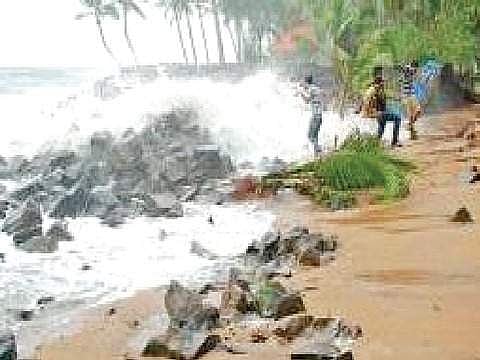

CHENNAI: Indian scientists have finally cracked the mystery behind the freak phenomenon called ‘Kallakkadal’, a colloquial term used by Kerala fishermen to refer to flash flooding events. In 2012, UNESCO formally accepted the term for scientific use.
For years, fishermen in Kerala and parts of Tamil Nadu have been bearing the brunt of high-energy swells, when waves of monstrous height of two metres hit the coast and plays havoc.
As all these happen unsuspectingly, Keralites call it ‘Kallakadal’ (in Malayalam, Kallan means thief or mischievous one and Kadal means sea).
To understand this phenomenon and develop models to forecast these events, scientists from the Indian National Centre for Ocean Information Services (INCOIS) conducted a study, which has been published in the prestigious Journal of Geophysical Research (Oceans) by the American Geophysical Union.

The study established with scientific proof that Kallakkadal events are caused by swell waves coming from the Southern Indian Ocean, some 6000 km away.
Co-author T M Balakrishnan Nair, Head, ISG Group, INCOIS, told Express that it was a significant breakthrough and now fishermen can see it coming and be prepared.
“A semi-operational wave forecasting model is set-up at INCOIS for monitoring and predicting Kallakkadal events. In fact, the system successfully predicted the recent occurrence of Kallakkadal events along Kerala coast during 2015-16. Once fully operational, the system can give specific warnings to authorities concerned at least 2-3 days in advance, which will help local authorities for contingency planning,” he said.
For the study, wave observation was done from four shallow water moored buoys and one deep sea moored buoy around the Indian coasts and Bay of Bengal. The buoys were located in Mangalore, Goa, Tuticorin and Ennore coast.
In fact, India is playing a lead role. “We have successfully deployed a Wave Rider Buoy off the Frigate Island, Seychelles, last year as part of the Integrated Ocean Information System for the Indian Ocean countries. Ocean state forecasts are imperative for safe navigation and operations at sea. India is serving as chair of Regional Integrated Multi-Hazard Early Warning System for Africa and Asia. Talks are on to set-up more wave rider buoys along the Sri Lankan coast, which will help to analyse and track high swell events originating from the Southern Ocean and arriving at southwest coast of India,” Nair said.
How the freak phenomenon occurs
Meteorological conditions in the Southern Indian Ocean create helpful conditions for generation of long period swells. These oceanic regimes are marked by strong westerly jet streams in the atmosphere. Low pressure cyclonic circulations will be formed within these westerlies, and move northward. These anomalous wind patterns have strong northward component, and they sustain over the ocean for a long period, typically around 2-3 days. These strong winds and availability of large ocean create helpful conditions for the generation of swells. These swells once generated, travel northward and reach the Indian coasts in 3-5 days time, creating havoc in the coastal areas,” he explained.
Tsunami vs Kallakkadal
During Kallakkadal events, the sea surges into the land and inundate vast areas. These events attract attention especially after the 2004 Tsunami in the Indian Ocean, since most people mistake Kallakkadal as Tsunamis. Tsunami and Kallakkadal are entirely two different mechanisms. Tsunamis are caused by landslides or earthquakes in the ocean bottom, whereas Kallakkadal are caused by meteorological conditions in the Southern Ocean, 30° South.
Significance
Severe coastal flooding events caused by the distant long-period swells is fairly well documented in other basins, but nothing much is done in Northern Indian Ocean basins due to lack of proper coastal monitoring and adequate high-quality observations. The swells generated in the extra tropical Southern Indian Ocean spread energy throughout the global ocean and are an important component of the global ocean wave climate.
Biggest event in recent past
One of the major events of Kallakkadal was reported in May 2005, when there was flooding of vast coastal areas of Kerala, damaging boats and fishing nets. The study confirmed that the 2005 flooding event was actually caused by swells coming from 5700km south from the Southern Indian Ocean.