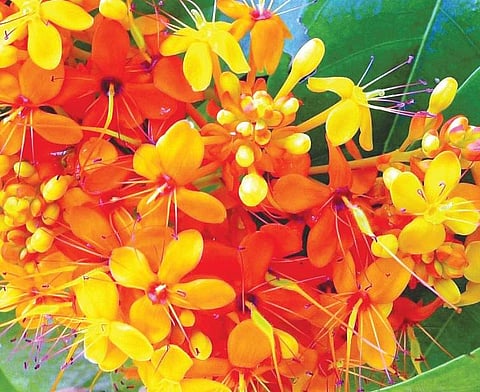

CHENNAI: Ashoka is an important indigenous plant with varied traditional therapeutic applications. Saraca asoca (Roxb.) WJ de Wilde is its scientific name.
Ashoka means sorrow less, says Maha Kavya ‘Ramayana’ and mentions Ashoka Vatika (Garden of Ashoka trees) where Sita was held captive by Ravana. In the calendar of Hindus, Ashoka tree is worshipped in the first month, Chaitra! It is also associated with Kamadeva, the God of Love, who included Ashoka blossoms as prime among the five flowers (the other four are White Lotus, Blue Lilly, Jasmine and Mango flowers) in his quiver.
One can also enjoy the images of Ashoka tree sculpted in the ancient Buddhist temples in Ranchi and Mathura!
The origin of Ashoka can be traced to Sirumalai region in Tamil Nadu by analysing its pattern of distribution through the peninsular India to North Eastern India. Sirumalai hills range acts as a common link of distribution as being the connecting point of Western and Eastern Ghats. The International Union for Conservation of Nature and Natural Resources includes Ashoka under threat status, ‘Vulnerable’ due to its depleting population in the wild.
It is a handsome evergreen tree, reaching 10 m tall and 20m spread. Foliage are deep green, densely clustered mildly fragrant flowers. Its flowering season is from December to April. Flowers are bright, orange-yellow, turning scarlet-red.
Fruiting is from May to July. Fruit is a pod, flat, looks like a bean, up to 20 cm long and 5 cm broad. Seeds are two to eight in number. Asoka is highly acclaimed for its utility in gynecological problems especially for excessive bleeding during menses, excessive white discharge, menstrual cramps and to treat female infertility. Ashoka is useful in bone reunion when the paste of bark applied externally. Flowers of Ashoka are known for its anti-diabetic properties. Oil prepared out of flowers is also useful against skin infections.
(The writer heads Centre for Herbal Gardens and Landscaping Services, FRLHT, Bengaluru)
