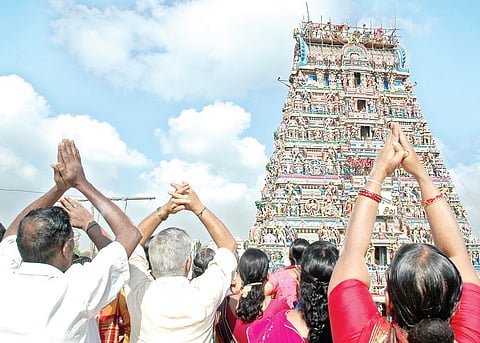

CHENNAI: As Chennai has expanded to encompass several dimensions, some parts of the city have retained its old world charm even as everything around it is caught in the whirlwind of change.
Mylapore, one of the most striking examples of age-old traditions meeting the glitz and glamour of urban living, deserves the ‘United Nations Educational, Scientific and Cultural Organisation (UNESCO) World Living Heritage Status’, according to the Mylapore Institute of Policy Research (MIPR).
Mylapore Institute of Policy Research, a think-tank for economic development, has brought out a policy paper on the scope for obtaining the UNESCO Living Heritage Status for Mylapore. Shiv Kumar, president of MIPR and the author of the paper, said that in Mylapore, worship, architecture, music and preaching came together to offer a unique spiritual experience while the community has also been drawn into a particular way of life, making a strong case for the status.
“In places like Chidambaram or Kancheepuram, the community is centred around the temple itself unlike in Mylapore, where the temples have created a unique ecosystem. I haven’t seen this anywhere else in the country,” he said. Sri Kapaleeshwar and Sri Adi Kesava temples have assumed a distinctive character in terms of captivating tourists while contributing to the growth of local commerce.
With a population slightly above 65,000 at present, Mylapore is the fabled centre of Tamil evolution where two streams of Hindu worshippers - Saivites and Vaishnavites - with their own set of religious practices had come together in harmony, offering an unmatched spiritual experience.
The author compares Mylapore to London’s St. Paul’s for being at the centre of the city’s bustle and yet beyond it, retaining its sanctity and spirit of life.
Apart from preserving the area’s heritage, obtaining the UNESCO Living Heritage Status is like ‘winning the Olympic Gold,’ said Shiv Kumar.
“Once the heritage status is granted, there would be significant benefits such as grants from international bodies to help make it a global tourist destination,” he said. The move would also be in line with the Chief Minister’s ‘Vision Tamil Nadu 2023’ that envisages an investment of `10,300 crore in tourism and hospitality sectors and attracting 1.5 crore foreign tourists by 2023,” according to the author.
UNESCO defines cultural or living heritage as “Traditional, contemporary and living at the same time: intangible cultural heritage does not only represent inherited traditions from the past but also contemporary rural and urban practices in which diverse cultural groups take part.”
According to S. Venkatraman, a member of MIPR governing council who has worked in UNESCO for 10 years, Mylapore would fit in better with the description of a living cultural heritage which goes beyond monuments and collection of objects. It also includes traditions or living expressions inherited from ancestors and passed on to descendants such as oral traditions, performing arts and socio-cultural practices.
