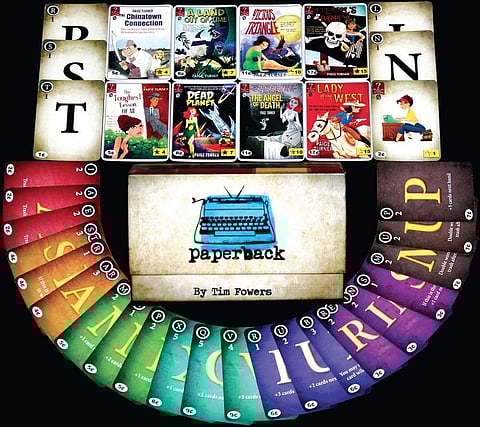

CHENNAI: Often, the easiest way of describing something is to relate it to other things that your audience might be familiar with. “Oh, you’ve got to try X — it’s like Y+Z!” — you’ve heard that before, haven’t you? Now, it may come across as lazy but sometimes it’s the most effective way of getting your point across — such as right now, for example, when I tell you that Paperback is basically Scrabble + Dominion (oh, and you should try it — it’s really good!)
Still with me? Good. Okay, confession time — I hate Scrabble. Actually, to be more accurate, I think Scrabble hates me. I’ve got nothing against word games — I’m a writer, for crying out loud! When I play Scrabble, though, my entire vocabulary goes swirling down the drain and all I’m left with is CAT for 5 measly points. That’s hugely frustrating, which is why I don’t care much for it. I wrote this entire paragraph to prove my bona fides to everybody out there who either dislikes word games or, like me, has been scarred by them in the past — don’t worry, I get it, I really do.
Which is why you should listen to me when I tell you that you should try Paperback anyway, because it is excellent. On the other hand, maybe you love Scrabble? Or Boggle, or Words With Friends? You should try Paperback too, it’s a wonderful take on the word game formula. Okay, enough praise — let’s start talking about the game. Paperback is a deckbuilding game where you buy cards with letters on them (mostly single, but some doubles too) and add them to your personal deck of cards. Over time, your deck becomes more powerful — which in Paperback, translates to you being able to make better words.
Because that’s how you get anywhere in Paperback — making the best word you can with the cards you’ve drawn from your deck this turn. However, cards don’t just have letters on them — they also have powers that can radically change what you’re trying to do on a given turn. Maybe this card doubles the score of an adjacent one, or maybe that card gives you +2 to your score if it’s the first letter in your word; the variety of powers available in Paperback is huge, and it keeps the game fresh from play to play.
There are two (actually, three) systems at work here that make this a substantially less frustrating experience than, say, Scrabble can be. First, you start off with 5 wildcards in your deck that can be any letter you want (and everybody also has access to a common vowel). Secondly, you choose the cards you’re adding to your deck; so if you get stuck with a crappy hand, it’s at least partly your fault.
Finally, if you know that there’s a good word there but you just can’t think of it, you can reveal your hand and ask the other players for help. If anybody suggests a word that works for you, you get to salvage something from the hand and they get a bonus point on their next turn — win-win! There are so many great things about Paperback that I haven’t even mentioned in this column, such as the wonderful art and the so-bad-they’re-good fake novels that you’re competing to ‘write’. But time is short, so I’ll just leave you with this — you really, really should try Paperback — it’s quite brilliant.