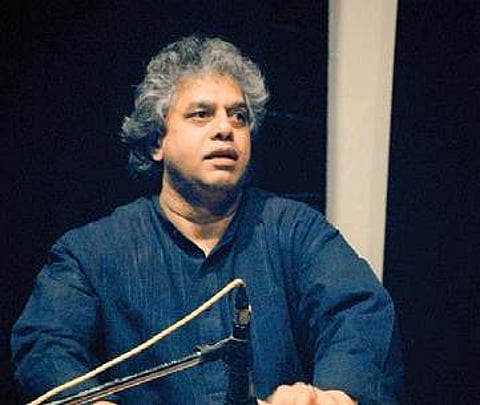

CHENNAI: W ell-known for his unique style of fusing Indian music with jazz and western classical music, Ustad Fazal Qureshi, Indian tabla player, comes from an impressive lineage of musicians. His father, the late Ustad Allarakha and elder brother Zakir Hussain, have carved a niche of their own. Qureshi will be in the city to share his knowledge on world music to the participants of ‘Music Camp’ at Swarnabhoomi Academy of Music. He speaks to CE about his experiences, where Indian music stands in the world and his latest works. Excerpts follow:
You’ve succeeded in merging a traditional Indian tabla with jazz and other western genres. How did it start?
It started as fun and became serious when I became more involved in it. While I was in college, we went to Delhi for a competition. While sitting in St Stephen’s college, a guitar player started playing Beatles’ songs, and I spontaneously joined him playing the tabla. Soon we realised that a nice crowd had gathered around us...that was an amazing experience. When we returned to college,
we formed a small band — a guitarist, violinist and I, and we had a concert in college itself with a huge crowd!
You have been associated with Mynta, (a Swedish fusion jazz band) for many years…
Yes, I created Mynta, and we have been performing since 1986-87. We travelled all over Europe, America, and China, performing and creating our own style. Our inspiration was my brother Zakir’s band, Shakti. For me, that’s the ultimate fusion music. It’s a way to mutually understand and feel music.
Having performed in so many international and national arenas, do you have any pre-performance rituals?
There’s always a lot of pressure, being the son of a very famous father and brother. So, you need to keep yourself as much at ease
as possible. I just talk to my co-musicians and joke around, and keep the air light. That’s the only thing I follow.
Where do you think India stands on the world’s music map?
In India, there is a pretty high standard as far as music is concerned. We can see many students come here to learn. Indian music fascinates the world, mainly because it has a strong base in sound curation. The spontaneous music creation and improvisations on stage that’s part of Indian classical music fascinates them. And also, many foreign artists coming to India to collaborate and perform is a clear indicator.
Tell us about your guru – your father?
My father has always been a guiding force and a very impartial guru. He always told me if I’m good enough, I will pick it up on my own and go ahead! And I follow the same rule. I look for the people who are good and encourage them.
What are your current and future projects?
I just finished an album with a percussionist from London. We sent each other our tracks continuously, adding to it over time. We didn’t fix any plan, we just sort of went along with our imagination and creativity. Apart from that, there are some more performances and projects in the pipeline.
What are your plans for the ‘Music Camp’ at Swarnabhoomi?
I’m coming here with a very open mind. I’m just going to ask the
students what they want, soak in the environment and then see what I can add. That’s the way I like to work.
He will be at Swarnabhoomi
till August 18. For details,
call 7299950087
