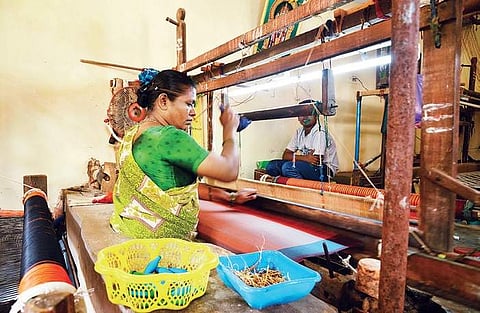

CHENNAI: Two weavers describe the plight of the disappearing weaving community in Anakaputhur. In the backdrop, there is the characteristic ‘tak tak tak tak tak tak’ of their last surviving pedal looms. One of them, Amarlingam, is dressed in a clean, white dhoti and a shirt that sports an expensive black pen. The other weaver, Sekar, is dressed in a threadbare lungi and a dull, fading shirt.
Sekar and Amarlingam are from the same caste, nearly the same age, have Telugu roots, and have even owned a similar number of pedal looms. However presently, Amarlingam has a regular income and has joined a different economic class. Sekar struggles to make ends meet. He lets out a sad laugh when asked him about savings. What then has pulled their lives so apart?
Amarlingam sold his pedal looms in 1995 and rented his workshops as residential tenements. Sekar chose to persist with the trade of his ancestors. Knowing that handlooms were losing out to powerlooms of big companies, Sekar reinvented his trade a decade ago, and began experimenting with organic fibres.
Since then, he has seen some success. The shawl his community wove out of 25 natural fibres adorned Prime Minister Narendra Modi at the first national handloom expo in 2015. But this achievement did not propel the weaving community, and he is currently struggling to keep his financials afloat.
“Most weavers have rented out their workshops, and the skilled labour force has migrated to find other employment,” says Amarlingam.
“A skilled labourer earns `5,000 per month, but security jobs offer twice with little physical exertion,” Sekar says.
A passerby joins the conversation. “No vehicles could enter the streets of Anakaputhur 20 years ago. This used to be primarily a weaving community and the finished fabric was dried on the roads,” he said. “I was also a weaver but my son is an IT professional.”
Until the ‘90s, residents of Anakaputhur claim that there were more than 5000 pedal looms in the temple town which recently became a municipality. “When I started weaving as a 12-year-old, this was our ambition. We took pride in our trade,” says Sekar, who still believes there is hope for his community if they stick to their roots.
Vijaya, Manjula and Venkatesan, the labourers in his shop, can’t imagine doing anything else other than weaving, but Venkatesan’s granddaughter, who was also in his workshop, says she wants to become a doctor. Being the president of the Organic Fibre Weavers Association, Sekar has been urging both the centre and State to help the weaving community of Anakaputhur.
Currently there are around 150 pedal looms in Anakaputhur, and Sekar dreams of an organic-fibre textile park and cross-border customers.
“Most of our customers are foreigners. If all the weavers are brought under one roof, our trade can greatly benefits,” says Sekar. The other weavers also nod in agreement. But Venkatesan’s granddaughter says that she still wants to become a doctor.
Lost in bureaucracy
The Ministry of Micro Small and Medium Enterprises has offered to provide `1 crore worth of machinery for the organic fibre weaving committee but it can’t provide the land and infrastructure for the proposed organic fibre cluster. Sekar had approached the district collector as early as 2012 for land to set up the facility.
The collector directed Alandur revenue department to make arrangements, but there was no response, said Sekar.
Sekar approached State planning commission. Letters accessed by Express reveal then member secretary had reverted petition for land to district collector.
Sekar approached Directorate of Town Panchayats. Proposal was forwarded by district collector by the assistant director, recommending it for the Tamil Nadu Innovative Initiatives Scheme. It then made its way to member secretary of the state planning commission for consideration.
But Express found that the organic fibre weaving cluster in Anakaputhur was not even on the agenda for 2015-2016.
Planning officer said it happened since proposal didn’t come from handloom department.
Director of handlooms said, “Allocating so much land for a facility will be a herculean task for district collector. Viability and marketing value are things that have to be considered.”
