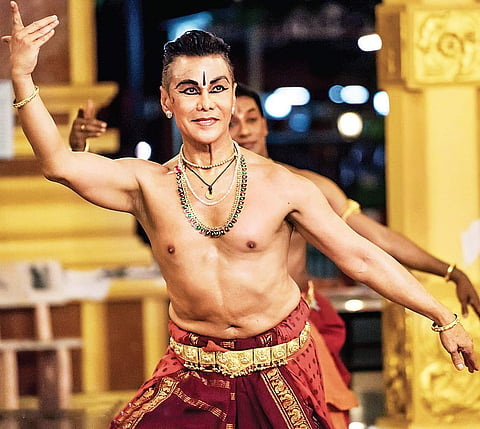

CHENNAI: Described by international dance connoisseurs as one of the finest artistes of his generation, Datuk Ramli Ibrahim has set stages ablaze in venerated centres of dance from Konarak and Khajuraho to Paris and New York for more than 30 years.
Ramli’s rigorous training in ballet, modern, and Indian classical dance reflects not only in his diverse technical accomplishment, but also in his multifaceted approach to the arts. Ramli believes in Martha Graham’s quote, ‘I did not choose dance, but dance chose me’ and feels that temperamentally he’s an artiste, always looking to promote the art, and as the founder of Sutra Foundation, Malaysia, he does just that. The renowned Malaysian dancer will be in the city for the Natyadarshan 2017 from Dec 22-24.

You’re trained in ballet and also Indian classical dance forms. How do you embrace the differences these dance forms bring to your regimen?
Dance deals with the body. In the Indian context, the body is a temple; but in ballet, the body is a palace, which has to be a wonderful instrument for expression. No concept exists in the world that cannot be expressed in dance by the body. And I stop at nothing to be the most efficient instrument for the arts.
Being a dancer is different from teaching a dancer — what are the challenges involved?
The core of dance is rasa, the way you express yourself through your expressions and body language, which is one of the most challenging things to teach. A dancer’s rasa determines the kind of emotions that are showcased to the audience, and if they can feel it, the performance is successful. This is the most difficult thing to teach to a dancer — you can easily teach the techniques, but the rasa is something dancers have to bring out on their own.
Do you think it is important for a dancer to experiment with various forms of dance?
In this day and age, it is very difficult to idealistically be just a Bharatanatyam dancer like Malavika Sarukkai. Each form of dance — Odissi, or Bharatanatyam, is an ocean, the depth of which can’t be fathomed in one lifetime. So you have to collaborate and be familiar with other techniques. I’m very much a contemporary choreographer and do a lot of contemporary work, and my dancers have to be versatile in my approach to dance. My dancers tend to be exposed to a number of techniques.
How has Sutra Foundation evolved over the past 35 years?
To a large extent, we still abide by our objective, which is to promote both contemporary and original traditional works and to provide a platform for young dancers to create. We have been going overseas, and thus act as a cultural brand ambassador for Malaysia, especially because my dancers are multiracial. We promote multi-culturalism in our work.
Bharatanatyam is fairly popular in Malaysia, and we believe you put Odissi on the Malaysian map as well...
Yes, the Tamil population in Malaysia is large, and there’s big traffic of Chennai dancers to Kuala Lumpur which facilitated a direct flight from Chennai to Kuala Lumpur (KL). And now, there’s a direct flight between Bhubaneshwar and KL! And with all this connectivity in business and economy, there must also be a cultural connection between these places.
You have a long-standing connection with Chennai.
Yes! My personal connection with Chennai started in the mid 70s. I trained in Bharatantayam with the late Padmashri awardee Adyar K Lakshman. He was one of the first direct disciples of Kalakshetra. He was a great guru with original compositions that had the Kalaskhetra learning, but evolving his own stamp. I have performed in the major sabhas from The Music Academy to Krishna Ghana sabha. I’m very familiar with Chennai and have great friends here! Many have come to visit me in Sutra Foundation too. We have grown together.
Your favourite Chennai memories?
There are so many! From meeting great gurus and Chandralekha, staying in the Theosophical Society and bicycling around the grounds with John Clarke, who was the editor of The Theosophist at the time. Once I remember seeing Rukmini Devi peeping out of her car window as we rode by (laughs). All these constitute a very deep living memory for me.