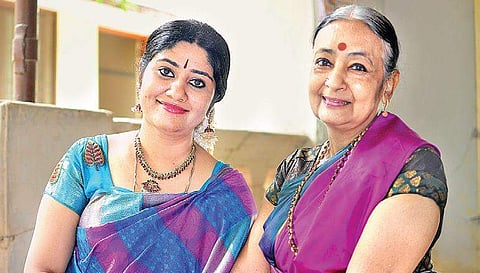

CHENNAI : With a art-rich lineage and being the granddaughter of the legendary musician Madurai N Krishnan, Sudha V Lakxmi took to dance like fish to water. She was five when she was taken to Shree Bharatalaya, an institution of fine arts, run by her grandfather, to learn dance. The rest, as they say, is history. A recipient of the Yuva Kala Bharathi award from Bharat Kalachar for excellence in Bharatanatyam, Sudha will be performing in the city today. The dancer takes us through her journey and carrying forward the legacy of her grandfather and also her guru — veteran Sudharani Raghupathy.
Can you tell us something about your first stage appearance?

I was just six when a thematic production was happening at our institute. And they wanted a little Krishna to crawl on the stage. So I appeared on stage as little Krishna and got good response. As a child when you get compliments, you are just happy and motivated to do more, right? And from then on, I played several roles — Muruga, Krishna, etc in several dance productions. It was only after a while I realised the importance of the art form and that’s when I wanted to take it up seriously.
Tell us about your guru, Sudharani Raghupathy.
She is every bit a professional. More than dance, I learnt the way of life from her. I have known her from my childhood, as our families are very close. Whatever I am today is because of her. She gives everything to the students. A guru-shishya bandham is there with her. You have also taken to teaching and have a dance institute. Shri Krishna Silambam was founded in 2014. My aim, when I started it, was to carry forward the legacy of Sudharani Raghupathy. We give equal importance to both theory and practicals.
How important is it for a dancer to know the nuances of Carnatic music?
It is essential to understand music and the rhythm pattern so that at a later stage dancers know what it is exactly and hence be able to do choreography. Another factor that matters is the abhinaya or the expressions — only when I appreciate the music, will I get the right kind of expressions. I need to take the music within me to express the mood of the raga.
What’s your dance presentation, Hari Sarvothama, about?
Hari Sarvothama explains the philosophical-spiritual relationship between Hari and the beings. My grandfather used to sing a vritam called Naham Vasami, wherein Narayana says, “I reside where my bhakthas sing my prayers.” So that was how this concept started. This idea popped up around six months back and when I showed it to my guru, she encouraged me to take it up.
I have taken verses from different composers like Saint Thyagaraja, my own grandfather, Agasthiyar, etc. and see their mode of bhakti. For instance, in Marugelara, Saint Thyagaraja says, ‘Why do you conceal yourself lord Rama, when I have directly perceived that you are everything and everything is within you?’ So it is basically an exploration on how various composers look at god.