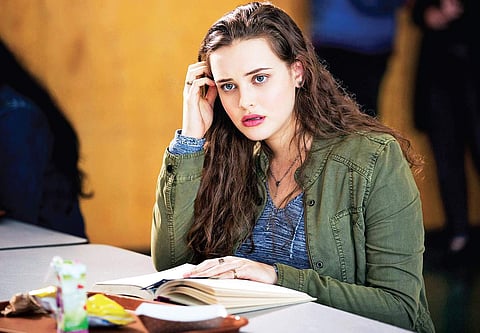

Netflix’s 13 Reasons Why deals with why a young girl decides to take her life and it has become a topic of discussion & debate. While experts say that the series could do more harm than good, teenagers in the city beg to differ
CHENNAI: I hope you’re ready, because I’m about to tell you the story of my life. More specifically, why my life ended. And if you’re listening to these tapes, you’re one of the reasons why’ — Hannah Baker’s voice rings clear across the tape, abnormally calm and composed for someone contemplating a suicide.
Netflix’s 13 Reasons Why is based on Jay Asher’s young-adult bestseller about Hannah Baker, a high school student who kills herself and leaves behind 13 audiotapes detailing the events that led to her death. In each tape, she expounds as the title suggests, the thirteen reasons why she decided to take her life, and the people responsible for it, either by their action or inactions.
The premise of the series was well-intended. It meant to demonstrate that suicide is not the option and that being kind to others and asking for help when you need are important. Yet there seems to be a wide discrepancy in the way people have perceived the topic, with some suicide prevention experts concerned that the series could do more harm than good.
For starters, the implication that suicide is caused by very specific reasons, is something most psychologists disagree with, saying the show portrays that suicide is an answer if you have enough reasons for it. Towards the end of the show, it is presented as though Bryce, who would have sexually assaulted Hannah the day before she took her life, taking responsibility for his actions is a potential way to get closure or justice for Hannah’s death — a false equivalence that runs counterintuitive to the series’ whole message, that the reasons someone commits suicide are complicated, varied, and often hard to understand from an outside perspective.
Sabrina, mother of a 15-year-old who watched the series back-to-back, is glad her daughter took a positive outlook of the series. “In the defence of the series, the message is that suicide is unreasonable. But as a parent, I'm worried why make suicide the focus of a story. What if somebody misses the point that suicide is ridiculous? My daughter felt it was silly, thankfully, but I don’t know how many people will be that mature,” she says, adding that the moment the series became a trend, it got more frightening. “There is a thin line between popularity and notoriety, and the message could be taken in any which way,” she quips.
Speaking to a few high-school students in the city reinforces that the series has been taken in its intended manner. “I realised every little thing we do as an individual to another person matters; even the things that you might’ve thought don’t matter or people won’t remember, because everyone remembers! I learnt that everything I say or do will affect another person, in ways that I can’t even think,” says 16-year-old Haniyah, a Class 12 student. Mubashira Banu agrees, “Even though Hannah wasn’t real, all the characters felt true. When Clay says ‘If at least one of us helped her, she would be alive’, I felt that’s what I want to do. I want to listen to people even if it’s for a minute.”
Having watched the series in three days, Haniyah felt the last three episodes were hardest to get through, especially the 13th which contains an intense graphic scene depicting Hannah’s final act. “Even though it was very hard to watch, somehow it made sense. Even when she was cutting her wrists, she wasn’t feeling anything, showing how numb she was from everything that affected her,”◘ she says. Banu adds that this scene shows bullies that it pushes people to painful ends. In a 30-minute featurette Beyond the Reasons, on Netflix, the show’s producer Brian Yorkey says that depicting Hannah’s suicide was a deliberate choice, stating ‘we did want it to be painful to watch because we wanted it to be very clear that there is nothing, in any way, worthwhile about suicide’.
While 13 Reasons Why doesn’t demonstrate its message with great finesse, it gets its message across; that sometimes the tiniest action can have the biggest consequences, for better or for worse. And more importantly, it’s important to listen and to express yourself, even if it’s difficult.
THE NEXT SEASON
Season 2 of 13 Reasons Why will release on Netflix in 2018. It would pick up where the first left off, with Clay coping with Hannah’s death and attempting to help others who might also have suicidal intentions. The season is also set to bring closure to another character’s suicide attempt in the end, and how the other characters implied in abetting Hannah’s suicide grow to accept their actions and cope with the guilt.
POP STAR SUPPORT
Selena Gomez, aside from serving as an executive producer, has a very personal tie to the show. She revealed she has had issues with anxiety, panic attacks, and depression and was actually going through a really difficult time when they started production, she told reporters at a press event. She, and two other members of the cast, Alisha Boe (Jessica), and Brandon Flynn (Justin), got tattoos together in support of Project Semicolon, a non-profit focused on suicide prevention.