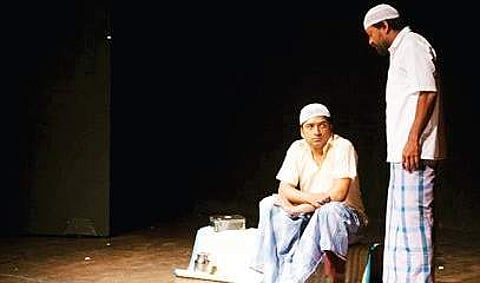

CHENNAI: Mundhirikotte is the Tamil word for cashew nut. But like many words in the Tamil lexicon, it is double entendre that also describes a person, who, like the protruding end of the cashew nut from its fruit, has a tendency to ‘jump the gun’ or be precocious.
In Sunandha Raghunathan’s latest play, Mundhirikotte, she explores the precocious burden of responsibility and choice that is placed in the hands of KP, a 12-yearold Dalit boy.
Commissioned and developed as part of the British Council and Rage Productions’ Writers’ Bloc Festival (along with the Royal Court Theatre, London), Mundhirikotte follows the lives of six individuals from three different faiths, all living in the real life town of Parangipettai — 40 km north of Puducherry, and yet, seemingly, an entire world away.

Sunandha has a passionate voice of a woman who is curious to understand the vastly different communities around her. “When we were doing the first few workshops for Writers’ Bloc, I realised that I wanted to explore the relationship between a teacher and student, to portray the dynamics of friendship in unnatural places,” says Sunandha.
“I wanted this play to be in a village setting. I have always seen these salt pans on my drives to Puducherry, and decided to visit one of these towns — Porto Novo, or Parangipettai, as it’s called in Tamil.”
Parangipettai literally means the white man’s land — parangi is derived from firangi, the Hindi word for white man.
Directed by renowned danseuse and LISPA graduate, Anitha Santhanam, Mundhirikotte’s central character is KP, whose mother Pavunu (played by Kalieaswari Srinivasan) works at the local salt pan. KP’s life becomes intertwined with two Muslim classmates, Ahmed and Basheer, and also his teacher, Selvaraj.
Ahmed and Basheer belong to the Maraikar community — descendants of Arab settlers who have, over the years, created a niche livelihood for themselves by building boats. When Anitha was signed on to direct the play, she and Sunandha visited Parangipettai. “I came in after the third draft,” says Anitha.
“When we visited the village, we observed everything — environment and the action. We took in the general atmosphere, and met the shopkeepers to understand everything about this place.” “When you look about in Parangipettai, you can easily differentiate between a Muslim and a non-Muslim,” Sunandha says.
“For lack of a better word, some of the Maraikar Muslims don’t look like typical South Indians — they have traces of their Arab ancestry.” The play, which premiered at Prithvi Theatre in Mumbai in early 2016, sheds a light on the nuanced communal tensions in the village, but without taking any strong stand of its own.
Was this a conscious choice? “Yes, of course. I can’t take a stand about this. My characters can, but how can I? My responsibility is to represent people without exoticising their plight. I don’t want to use them as a mouthpiece to discuss my own politics.” Before Mundhirikotte, Sunandha had only written in English. “But when I started doing all these writing exercises, I started thinking and writing in Tamil, and I felt so free. And it’s a colloquial Tamil that the characters speak. And I don’t understand why people are surprised by that choice.
I mean, after all, in our daily lives, we do a lot of things in this language — we have fights, arguments, and even sex in colloquial Tamil, and using this language is an incredible honour,” she laughs.
With a resplendent set that evokes the shores of southern Tamil Nadu, and the use of stylised physical theatre to animate Sunandha’s words, Anitha has directed a play that is almost lyrical in its tone. With five performances already under their belt, the Mundhirikotte team is eager to take their story to more across the country.