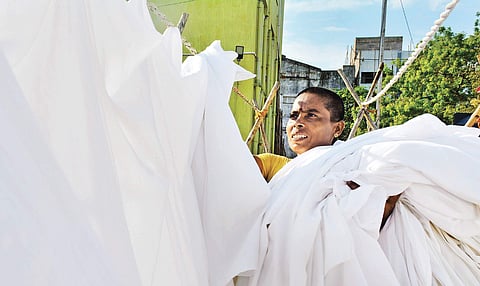

These century old dhobhikhanas in the city are close to shutting down entirely for several reasons. Take a tour of these khanas in Saidapet, Washermanpet and Mylapore as our reporter explores and highlights their history, daily lifestyle and the future prospects of a dying profession. Photos and story by Abinaya Kalyanasundaram
Lines of freshly-cleaned clothes hanging to dry in the sun, gently teased by the moving winds; a steady rhythmic slapping and splashing sounds indicating more clothes being washed in the symmetrically arranged washing stones placed at the back. Sounds and looks fascinating, doesn’t it? — No, not entirely. Life at a dhobikhana is hardly as clean and enticing as it looks.

Rising at 4 am every day, picking up a pile of dirty clothes, soaking in preciously scarce water then beating the same on stones, squeezing then laying out to dry — all under a progressively searing heat in an open air pen area, which is necessary to keep the clothes clean and the area less damp. This goes on until the pile lessens, or the sun sets, whichever comes first, with each dhobi washing over a 100 clothes a day.
Chennai has over 14 dhobi khanas, varying is size and status of work —some dhobis are still flourishing with regular piles of clothes, while others are shutting down due to no work or lack of incentives.
Runs in the family
An important factor in sustaining a dhobi family is the unity and co-operation between the family members to finish a day’s work. While one person washes clothes, another hangs them to dry while others bring water, or collect/distribute clothes. Over the past 20 years, with the younger generation stepping out of the compound to embrace diverse careers, the continuity of the dhobi community remains a question: who will wash your clothes and iron your formals if not these dhobis? But why should they continue a 12-hour-a-day profession to earn a fraction of what you earn? Perhaps the solution lay in betterment of
their conditions.
Old Washermanpet Dhobikhana
Wandering through the narrow lanes of Washermanpet, I reach the very end of Kothandaraman Street; the lines of hanging clothes indicate I finally found the right place after an hour’s search. The thalaivar, Arumugham, emerges from his ironing cart right at the entrance to welcome me.
Arumugham’s father, Subbaiyah came from Virudhunagar, started this khana with the permission of the British in 1937. This was undertaken by the government in 1979. Over 100 families (more than 500 people) reside on the 16-ground area. Every day, the workers work from sunrise to sunset, taking a holiday only on the last Friday of the month. All of them are from descendants of the same family, and they take pride in their livelihood.
The community has five temples within the complex, with the main washing area in the centre and houses around the periphery. Clothes are dried on wide terraces. A central water tank provides the required water from a borewell. Though over 12,000 litres is required, only half of that is available from the existing borewell, placing the dhobis in a precarious position. Maintenance of drainage and cleanliness also seem to be a far cry.
Washermanpet receives clothes from residences, hospitals and restaurants in the vicinity. The dhobi families also collect door-to-door, once every week. Each family has its own regular customers and designated areas from where they collect clothes. They identify their set of clothes with initials, or other markings and claim a strong 25-year relationships with their customers.
Saidapet Dhobikhana
In pre-independent India, when Adyar river was flourishing, a community of dhobis congregated on its banks. However, with the frequent floods and fires, they were shifted to a compound by the then chief minister Kamaraja where they have been living for the past 50 years. Presently the 52-ground space hosts 356 families living in ‘oyvu araighal’ built by the government – a single room 100 sq ft space. These were meant to be resting and storage places, with toilets located at the corner of the settlement. But the people made these rooms their homes as they had no place else to go.
They are now requesting the government for homes similar to the 400 sq ft home apartments being built at Tiruvottriyur dhobi khana. The community here has adapted and diversified in its profession. For instance, there are families which go out for dhobi work at commercial units, and return here to either do more work or call it a day. Some have part-time jobs apart from washing, while some others run laundry shops outside. VP Gandhi, the secretary here, says, “The dhobi profession will continue to survive. There are still few people who don’t want or cannot get into other professions – so they will definitely continue this profession.” Saidapet too faces a water crisis, and families take turns every day to wash clothes.
Mylapore dhobikhana
Smaller than the others, the Mylapore dhobi khana has been in undocumented existence before it was taken up by the Chennai Corporation in 1952. On the three-ground area, there are about 48 families who earn their livelihoods. Their homes are located outside the compound.
Over the past years, the change in cloth types has made it easier for the washermen, claims Murali, a 45-year old.
Earlier, only cotton clothes prevailed; to wash stubborn stains off them, a specialised kiln-like equipment was used to steam them. The kiln would be fired with firewood and soaked clothes will be arranged over the copper kiln, till a height of about two feet. The steam would help ease out the dirt from the wet clothes, after which it will be taken out, washed and then starched, dried and ironed. The whole process takes an additional two-hours. These days, even starching is done only for a few customers who request it. Otherwise it’s a simpler process of soaking, wringing and washing, then drying.
Other dhobi khanas in the city
Chetpet — The washing tanks and cleaning rocks created by the British has been the sole breadwinner of washermen folk, till now. Built in 1902 by Sir George Moore, president of Madras Corporation, this is the oldest dhobi khana in the city. Earlier, 300-500 people lived here. Now, their fifth generation people are living here. There are few more located in Adyar, Thiruvanmiyur and Thiruvottriyur.
Ironing
Most khanas have ironing sheds or rooms within their compounds, while others have sheds scattered around their neighbourhoods. They use the traditional irons with heated coal, as it’s more effective than electric issues. Each day an average of 2 kg of coal is used, for `50 a kg. The 6 kg irons are replaced every two years. Ironing starched clothes especially is a task as it will sometimes get deformed while starching. Even with washing machines replacing the profession, ironing still doesn’t have a mechanised doppelganger that’s kicking it out of business...yet!
The problems
Scarce water, a catastrophe for dhobis
Improper living conditions with no incentives in place
The advent of washing machines that threaten their livelihood
Unpredictable daily wage, affected by these issues
Dhobi – the caste
Dhobi is the name of the washermen community. This name has been derived from the Hindi word dhona and the Sanskrit word dhav which literally means to wash. In Tamil, Dhobhis’ are called Vannar. Other names include Vannan, Panicker, and Salavai thozhilalee. The dhobis in Northern India come under Scheduled Castes whereas in South India, except in Kerala, they are backward class. This disparity has prevented dhobis from receiving government benefits.
The dhobi app revolution
Most laundry and dry cleaning outlets in the city give their orders to dhobis for cheaper labour. This is helpful in a way, as it provides wages and work to dhobis who may otherwise be replaced entirely by washing machines.
In movies
A brief look at the life of dhobi folk was seen in the Tamil period drama film Madrasapattinam (2010), where the lead character Parithi, played by Arya, is a dhobi living in Madras. There are several scenes showing the lifestyle and community of dhobis in the British era.
Wring. Rinse. Dry. Repeat.
The procedure is seemingly simple enough, but in reality it’s a lot work and takes time to get your clothes form the pile to line. Clothes received are soaked in soda and soap-oil water the previous night. The next morning, they’re brushed, rinsed and the beaten on the stones to remove all water. For white clothes, indigo (neelam) is used. Or a mixture of bleaching powder and aapa soda mixed in water. The bleaching powders should be used cautiously, else it may damage the cloth.
Economics of the dhobi life
Revenue:
Daily wage ranges from Rs 200 – Rs 1000. It is highly unpredictable based on the clothes received each day. Some families in the khana have permanent contracts with hospitals for monthly wages – Rs 10, 000 -15,000.
Rs 25-30/- per cloth, inclusive of ironing. Additional Rs 5 for starching.
For silk saris, it goes up to Rs 150. They are polished, rolled then delivered.
Expenditure:
Washing soda – Rs 60; Javuarusi maavu (starch) – Rs 80
Rent – For washing stone Rs 6 per month; for living quarters Rs 50 per month