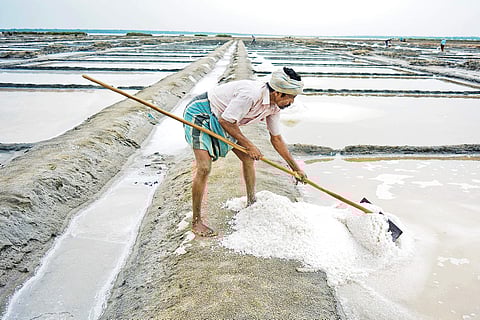

Along the stretch of East Coast Road toward Pondicherry, you will cross the ancient port town of Marakkanam about 120 km from Chennai. Crossing the mouth of the Buckingham Canal, the trees lining the highway give way to expansive panoramic fields with row upon row of square water patches. Spread over 4,000 acres, the Marakkanam salt pans are the third largest producer of salt in Tamil Nadu.
As we walk towards the grey and pale blue landscape, broken by small piles of white crystal salt shimmering in the sun — the pretty picture does well to hide a not-so-pretty condition of salt production here.

Abinaya Kalyanasundaram walks through the mounds taking pictures and giving you an account of the town’s history of what was once the most important currency during trade (salt) and see lives of those who are steeped every day in the corrosive, scorching evaporation ponds raking out crystal salt.
What’s in a name?
Right at the entrance to the town is Bhoomeswarar temple, a 1,000-year old Shiva shrine. The myth goes that a devotee, on his way to to Kasi on a pilgrimage, stayed in the area for a while. He placed a marakka — a pot used to measure rice and grains — and prayed to it considering it Shiva. Over the years, the marakka disappeared — some say stolen, while others claim it was buried. While digging up the place where it was known to stand, they discovered a lingam. The word marakka kaanom, which means the maraka is missing, became ‘Marakkanam’. There are even myths that say recent excavations near the Bhoomeswarar temple turned up copper coins and rings, and other objects from the medieval periods.
From water to salt
Salt pan work begins during early January. Preparatory works take around two months, to undo the damage of the rains to the pans.
Firstly, the land will be levelled. Sea sand will be brought in and labourers stamp in the sand and mud for days to bring it to a levelled state. The furrows and bunds will be repaired and built again.
Salt water stored in a separate reservoir is opened and allowed to flow into the separate pans through a connected pipe system; once water is filed halfway in each pan, the pipes are sealed.
Water is exposed to sunlight which allows the temperature to rise. The salt settles at temperatures of 24-25 degrees.
After three to four days of standing, the settled salt is raked in. It’s a laborious long process, and the collected salt is taken to bigger piles, covered under blue tarpaulin sheets.
Life of a salt pan worker
Over 4,000 acres of Marakkanam salt pans are leased out to individuals, who hire their own workers. Around 1,000 workers can be seen working every day during peak season. Daily work starts from 6 am and goes on till 2 pm with breaks for meals in between. The men rake while the women carry piles from the pans to the large collective pile, but this divide is now blurred with both doing all jobs. The payment divide is, however, stark and clear. Men receive `400 per day, while women get a mere `150 a day, a salary determined on the assumption that men work for five hours a day, while women work for two.
How it began
Salt was a very valuable commodity in ancient times. In fact, the word ‘salary’ is believed to have its origin from the word salt. In Marakkanam, all land under salt production belonged to the temple, until the East India Company brought it under its control. The government established monopoly on salt trade under which manufacturers were required to sell salt to the Government at a fixed rate. There was a port here during the Sangam period, and historic references indicate trade was carried out here during the Nalliyakondan’s rule. A few kilometres from Marakkanam are the ruins of Alamparai Fort, which served as a port during the 1700s, and salt being a prime commodity of trade, many traders. settled in the region.
Seasons of salt
Salt production in Marakkanam starts from January and goes on till August, peaking during the agni natchathiram months — April and May (peak summer). While farmers look up expectantly for rain, salt pan workers look up fearfully when grey clouds approach. During rainy season, water temperature drops to 6 or 7 degrees and rains disturb the settled salt in the pans. And once the Buckingham canal floods, the entire area is submerged in water. During rainy seasons, salt pan workers find other odd jobs to survive.
Marakkanam’s decline
With a rise in prawn fishing culture in the region, the wastewater from these culture farms are disposed into the backwaters, which adversely affects the water used for salt production. There is also a decreasing number of salt labourers owing to the adverse working conditions, lack of incentives and unpredictable weather which affects production.
Wholesale rate
Marakkanam produces only common edible salt. The common salt that’s collected is distributed wholesale to Andhra Pradesh, Karnataka and Tamil Nadu. The raw crystal salt, or ‘kallu uppu’, is sold wholesale to nearby towns as well. The cost of salt is determined by its whiteness. Good white salt gets sold for over`120 per bag which is around 100 kg; that’s approximately 1 kilo of salt for `1!
Other salt pans in TN
Tamil Nadu is the second largest producer of salt in India next to Gujarat. Salt pans are possible in swampy areas, where sand and mud co-exist, called kazhivelli in Tamil. Proximity to the sea is an obvious mandate. Tamil Nadu’s major salt production areas are Thoothukudi and Vedaranyam, followed by Marakkanam. There are also small pans that produce industrial salt near Mahabalipuram, and in Chooonambedu and Cheyyur in sparse quantities.