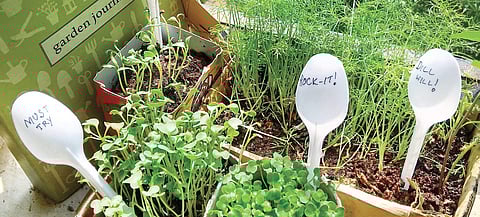

CHENNAI : A generous sprinkling of finely chopped mint, coriander, parsley and basil makes even the much-maligned buttered mashed potato look like a saint of a dish. For amateur gardening buffs like me, the best thing to do is to grow herbs and microgreens. Microgreens are the little greens that are older than sprouts but younger than baby plants. In case of sprouts, we eat it all of it – shoot, root and swollen seed. In the case of microgreens, we only eat the shoots. The rest stays underground. Once the crop is used up, you can just dig up the patch and leave the roots there as extra nutrient for the soil.
Microgreens are very easy to grow and use. Sow some seeds in a shallow container filled with a potting mix. Keep it on a windowsill. Water it very lightly. Depending on the seeds, you’ll see tiny greens lifting their heads out of the soil. In three to five days, they will be standing upright. And from then up to 15 days, you can start snipping off a few to put on your salads, sandwiches, curries, juices, paratha fillings, and just about every other dish — unless of course, there is someone in the family who dislikes pretty garnishes and throws both you and the greens out of the balcony.

Radish seeds, horse gram, beets and basil are excellent candidates for your microgreen experiment. Microgreens are crunchy and have the concentrated taste and pungency of the particular seed. For instance, mustard microgreens can be quite sharp and tingle the palette a bit. Saunf (fennel) microgreens are usually sweet. Methi (fenugreek) microgreens are sweeter than the fully-grown leaves. We’ve read that microgreens are extremely rich in vitamins and other nutrients, and I’m truly convinced. How? Because a couple of years back, after I spent a month chewing microgreens every evening straight from the garden, my hemoglobin levels seemed to have shot up and I felt so full of beans. (Or was that because I chomped on a lot of tender, winged-bean leaves that had taken over the terrace corner for a bit?)
Some vegetables such as cabbage broccoli, arugula (rocket), and therefore, their microgreens, are excellent sources of magnesium, potassium and vitamins. Kohlrabi (navilu kosu/knolkohl) microgreens are rich in iron. There are several research studies that confirm the good things being said about microgreens, but to me the best reason to eat them is that they can be grown with so much happiness. And happiness is great for the heart and mind!
Sometimes, I let a few microgreens grow and then, if I’m lucky, the plants yield flowers and seeds. Then the squirrels eat them up, and probably bless me! Sometimes, they let some seeds be, allowing me to harvest a whole big handful of mustard seeds. Once a week, just to heighten the health and taste quotient of the dal, I pluck all the spinach that grows in various pots in the balcony. The other day, I got a handful of red amaranthus, palak, gongura, purslane, curry leaves and coriander and two shiny green chillies. The dal tasted great, even if I say so myself.
(Do you have an organic gardening query related to small spaces? Please write to mala.kumar@yahoo.co.in)
Easy to grow microgreens
Keep it on a windowsill. Water it very lightly. Depending on the seeds, you’ll
see tiny greens lifting their heads out of the soil.
Candidates for experiment seeds, mustard, methi, saunf, moong, alfalfa, horse gram, beets and basil are excellent candidates for your microgreen experiment.
Great sources of vitamins
Some vegetables such as cabbage broccoli, arugula (rocket), and therefore, their microgreens, are excellent sources of magnesium, potassium and vitamins.