
CHENNAI: A crowd had formed at the Siva temple grounds in Palavoyal near Red Hills. A seven-foot bull galloped across the grounds, its loud huffs a threat to skewer anyone who crossed its path. Dawn Williams, chief rescuer at the Blue Cross, stood at one end of the ground, shouting instructions to two of his volunteers. They managed to lasso a rope around the beasts left horn. With expert precision, they looped the rope around the neck of the bull and pulled its head to the ground. Quickly, one volunteer bound the bull’s forelegs as the other tied its hind legs. The beast has been captured.
With the help of a veterinarian, the bull was sedated and loaded into the Blue Cross’ animal ambulance. His angry huffs could be heard from 10 meters away, and the villagers steered clear of the vehicle it was in.
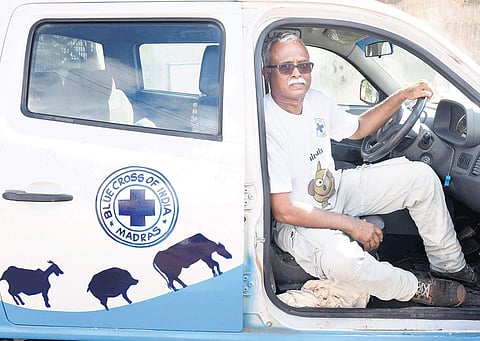
“This bull has attacked over 100 people and injured over 50. It has even killed an old woman and a child in a fit of aggression,” said Williams, as he climbed into his rescue vehicle and started following the ambulance. They were headed back to the Blue Cross facility in Velachery. “The poor animal has consumed a lot of plastic waste and is now puking green goop. We will be able to treat him and find out why he has been so aggressive,” he added.
Beast friends
A village boy from Villupuram, Williams has always been accustomed to the company of animals. “My father reared cattle and we grew up caring for them,” he said. Growing up, he was keen to join the Indian Armed Forces and trained as a commando for around 15 years. After an early retirement from the Army, he joined an electrical company in Neyveli as fire and securities manager. “There were a lot of human rescue techniques I applied there to avoid fire hazards and electrical accidents,” he said.
He returned to Chennai in 2010. He immediately joined the Blue Cross as a general manager and was later offered the role of chief rescuer at the Blue Cross by 2015. “There is a way to avoid provoking an animal. Because animals are unpredictable and there is an acute shortage of food in the country, it’s best to avoid confronting a restless animal. Most humans confront the animal because they have false confidence or want to take care of the situation themselves. Most of the times, that is the reason the animal attacks in the first place,” he said.
Suspenseful saves
With over 20 years of experience in human and animal rescue, Williams has taken his team to help during cyclones Fani and Vardah. “Rescuing a live animal is not difficult because it will react to your touch and move. Our biggest challenge was when we had to move animal corpses to avoid the spread of diseases. We have to make sure that they don’t burst or leak any fluids while being loaded onto the truck,” he said.
Recounting a chilling experience, he said, “Once, we got a call about a bull that had been hit by a train and had landed 30 feet above the ground, on top of a pillar. We couldn’t use a crane at the time and relied solely on our ropes and pulleys to get the corpse down. Everyone thought that the bull will fall and splatter, but we don’t do trial and error. Our rescues are all pre-planned and everyone on my team knows exactly what to do in any situation. Trial and error can worsen the situation,” he said.
Full-time job
Always ready, Williams had appealed to the district comissioner of Tiruchy to allow him and his team to help rescue Sujith Wilson, the boy who recently lost his life after he fell into a borewell, but didn’t receive a response. “We could have rescued the boy in the first 20 minutes, avoiding any mishaps that made him fall even lower into the hole,” he said. “Rescue is about saving human life. You cannot go to the site of the accident and then figure out what to do. You will be wasting precious time and it is an insult to the value of that human life,” he added.
But rescue doesn’t just end after the victim is saved, he explained. “A rescue is successful only when you involve the government, the police, the firefighting department and the demography of the area. Only then will you garner enough support to carry out a clean rescue. Even elements like topography and light have to be taken into consideration before performing a rescue,” he said.
Williams has trained over 150 volunteers during his time with the Blue Cross. “One of my students is now working in an animal welfare organisation in Romania, but I would still say that the best is still in Chennai,” said Williams. His volunteers train mostly over the weekend when they are free. They train throughout the year, preparing for most situations. Depending on their response to the training, he allows them to participate in live rescue missions.
