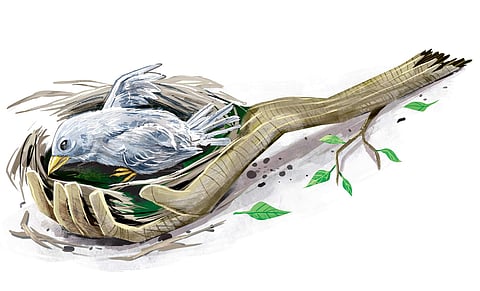

CHENNAI: Benu Baneerje* was hardly 30 when she was offered the role of chief audit executive at a well-established Chennai-based private organisation. Without a second thought she declined the offer, and strode home with a pack of crayons — all to be welcomed by the laughter of her adolescent autistic son Adhvaith*.
“We were able to understand and diagnose that he has high-functioning autism only two years after he was born,” says Benu. “Soon, Adhvaith’s father passed away due to a heart condition and I became the sole caregiver. Taking up a higher position meant a dearth of time to care for my son. So I decided to continue in a sub-position,” shares Benu, who is now 60 years old.
Dressed smartly in crisp white shirt and custom-made pant, 40-something-old Adhvaith is at his workstation, dabbling with garden twine, paint and some glitter. His eyes are glued to an assistive laptop on the table. He diligently follows the instructions, prepares a DIY pen stand and hands it to his mother.
“Every child is different. I was fortunate to identify his interest in arts…that’s how he communicates,” she says. After Rani amma, their caretaker, guides Adhvaith to his room, Benu with a bleak smile asks the perennial question that plagues the minds of ageing parents caring for adult children with life-long disabilities, “When I am no longer around, who will replace me?’.
On November 1, Express reported that 88-year-old Viswanathan, a retired Central government employee from Teynampet killed his 44-year-old son Venkatraman who had an intellectual disability. Worried that there is nobody to care for his son, the octogenarian gave his son an overdose of sleeping tablets, and even attempted suicide.
In the wake of such incidents across the country due to the near absence of institutional support, lack of safety, resources and social inclusion, parents-turned-caregivers from different pockets of the country have started taking matters into their own hands. From setting up long-term plans for their children — estate planning, finding suitable housing to forming guardian communities, a long list of admirable initiatives are being chalked out to provide them with a better future.
After the incident was reported, several parents of children and adults with disabilities opened discussions on the future of their children. But, a thread of empathy for the 88-year-old is what connected the parents. “We are not justifying the death or the action. But is it okay to say that we understand the isolation, lack of support and fear that the parent might have gone through?” asked a parent on condition of anonymity.
Battles & solutions
“The government-run institutions mostly cater to the underprivileged. Most times, these places lack facilities, are at their full capacity or are only temporary solutions to a life-long situation. So, several private initiatives and group homes — an attempt to build a community that answers the questions of ‘what after me’ are being set up.
Another interesting initiative is the propagation of Supported Decision-Making (SDM), a set of arrangements designed to aid Persons with Disability to make decisions about their life and communicate it to others,” shares Gopinath Ramakrishnan of SCAN, a parent support group for families with special needs.
The growing need for a safe and inclusive community has given birth to parent-led initiatives across the country. Sharing the concerns and the everyday fierce battles of several other parents, two years ago, Gurumurthy, father of 24-year-old Varsha and 15-year-old Sreedhar — both autistic — along with a group of like-minded parents decided to develop a ‘special’ facility — Community Living Association for Parents of Special Citizen (CLAPS).
“Two years ago, when my parents and in-laws were hospitalised, my wife and I became their caretakers too. We decided to send our daughter to a boarding facility for the time being. But, we had a hard time finding a good one. In most cases, when children are sent to such alien residential facilities, a sense of anxiety kicks in. They become worried if they will ever meet us again. We didn’t want our children to live with that anxiety and that triggered the idea to form a community of sorts, where parents of children with disabilities will live as a joint family,” says Gurumurthy.
“This way, even if one parent dies, the other families will step in to take care of the children. We are all sailing in the same boat. The group has identified a property near Tiruvallur and will soon begin construction of the community home. “Over the course, the families have been spending time with each other, familiarising children with the people to make it a safe space for them to live,” he shares.
With a very few existing (and some times non-existent) pay-and-use government-run Gharaunda Centres in the country — spaces that provide life-long shelter and care for persons with disabilities, the inadequacy of good centres have led Good Samaritans to come forward to set up residential facilities that not only provide boarding, but also equip special children and adults with life skills.
Residential facilities
To address the vulnerability and exclusion that persons with physical and mental disabilities face, G Karthikeyan founded the Sristi Foundation and set up Sristi Village in Thazhuthali, Villupuram. “There was a need to provide opportunities to empower PwDs who were more often than not too old for special education but were willing to contribute to the community,” shares the activist.
Apart from providing a training centre and a working place that allows PwDs to explore their potential, the organisation also trains them in agricultural practices. “When persons with disabilities grow old, their energy levels spike. When they are institutionalised and have to follow a certain regime or have to live within four walls, it turns into aggression.
Allowing them to be one with nature and learn the agricultural practices was a way to create an all-engaging space,” he explains. While the organisation currently closely works with children and adult males, soon, an inclusion of opportunities for women with disabilities will also be available.
Autism Ashram in Hyderabad has also become a noteworthy care home for both short-term respite stays and lifespan services. “With reports of abuse and deaths in government homes and non-regularised shelters surfacing now and then, parents don’t want to part with their children and send them to such homes.
By the time they decide to let go of the child, it becomes extremely tough for both — the parent and child to live without each other. This is why I often reiterate the importance of long-term planning for the child and why it should start at a very young age. Plan while you still can,” shares Anil Kundra, founder of the commune, adding that the role of district administration in reaching out to senior citizen caregivers and proving counselling to them plays a vital role. “An Autism Guardian Community comprising 80 families with special needs will soon be set up in Hyderabad,” he adds.
Care for caregivers
From dealing with puberty, sexual development stages of an adult with disability, ensuring hygiene and self-care and assisting with basic daily activities including the visits to the toilet — parents dedicate their lives to care for their children. To meet the special needs of her adopted third child Moy Moy (late), Jo Chopra McGowan co-founded the Latika Roy Foundation (LRF), a voluntary organisation based in Dehradun, Uttarakhand.
“One of the things that struck me after my daughter died was a tremendous weight that lifted. It made me aware of how much mind space anxiety occupies. Though we had a wonderful network of people who were willing to help, you always know no one can love your child as much. The anxiety never leaves,” says Jo.
“That’s why when parents know that their child will overlive them, we at our organisation push parents to think about their future from a young age. We have to help families build a network and not isolate themselves during the journey,” shares Jo, who has been working towards providing specialised services for almost 300 families.
Institutional care becomes the last choice and is not a humane answer to the plaguing problem. “The government has to play a significant role — in not just providing schemes and shelters but also in acknowledging the tremendous service of caregivers who are looking after people without any support nor compensation. They have to be recognised, they can be given a stipend and some kind of social structure should be put in place,” she asserts.
Some leave their day jobs to become full-time caretakers, some have never taken a break or a weekend vacation in 30-odd years, for some, their marriage turns sour and familial and societal support becomes bleak — they break, they fall apart. “Death or murder can’t be justified. Did the 88-year-old caregiver get a break, when was the last time he went for a walk or the last time he had an avenue for help? A support system should be in place,” she says. Perhaps then, in an evolving and inclusive society, Venkatraman would have been able to live too.
(*Names changed to protect identity)
