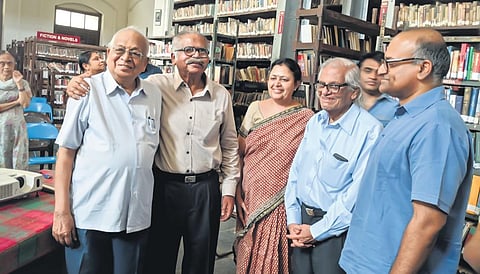

CHENNAI: Origin stories are tricky to nail down. Especially when it’s the origin of a city, which was once a princely state, which was once a cornerstone of trade under different empires spanning numerous centuries, which (at least part of it) once held paleolithic settlements. So, how do you go from there to developing a robust tradition of celebrating the city and its birth with such sustained enthusiasm? Well, it takes a lot of people, a few clerical errors and plenty of goodwill, suggests V Sriram. In an attempt to tell the story behind Madras Day, in an online event organised by DakshinaChitra Foundation, the historian and heritage activist pieced together several historical anecdotes that made way for this iconic day and the many experiences it has offered in its wake.

Of history and errors
To understand how Madras Day came to be, one has to know how the city itself shaped up. Long past the paleolithic age, after the Sangam era, there is evidence to show that there was already a village by the name of Madraspattinam when the Britishers set shop around present day George Town in 1639. It was in 1939 that the government put together a Madras Tercentenary Celebration Committee, which came up with the Madras Tercentenary Commemoration Volume. “That indicates that they accepted that the city was 300 years old (at that time). They were essentially looking at the history of what had happened during that period. A whole lot of scholars wrote articles that were published in this book and it still remains an excellent reference volume. This, therefore, became the basis on which subsequent celebrations of the city were taken up,”
Sriram recounted.
However, the exact date of origin has always been something of a controversy, he admitted. Henry Davison Love, in his Vestiges of Old Madras, documents the journey of Francis Day, the first Englishman who arrived here from Machilipatnam and obtained the grant for the land upon which Fort St George was to be built. While the document is dated July 22, Love’s record doesn’t place Day in the city till much later. So, the author offers that it was probably August 22 and someone had gotten it wrong in the grant. “It’s on the basis of that error that we continue to accept August 22 as Madras Day,” Sriram explained.
The infant years
While Madras Day celebrations on the scale that we see today wouldn’t happen till 2004, it registers its early beginnings in 1989 with the 350 Years Madras: Quiz Book by Navin Jayakumar and GS Praveen. This event also marks the active arrival of the late historian S Muthiah to the proceedings. That year, he marked the occasion with a coffee table book titled Madras: A Gracious City, tracing the city’s many iconic monuments. In the years that followed, several developments allowed for the creation of a ecosystem that nurtured the Madras Week celebrations,
Sriram pointed out. Madras Musings became a fortnightly with a wide readership and corporate support, Muthiah’s Madras Miscellany column in The Hindu had become household knowledge and INTACH (Indian National Trust for Art and Cultural Heritage) was doing a lot of heritage preservation work, and the success of Mylapore Times under Vincent D’Souza had led to other local dailies coming up around it. The 2004 revelry came about because of “three wise men” — Muthiah, Vincent D’Souza and Sashi Nair (of Press Institute of India, Taramani).
“These men came up with the idea that the city needed a day to celebrate itself. And there was a lot to celebrate. By 2004, the economy had liberalised, Chennai was established as a great centre for automotive and component production, an IT centre, a leather centre, an education capital, a medical centre. It was a thriving metropolis. The other aspect, which is forgotten, is at a time when there is so much polarisation, Chennai was and remains a place that accepts pluralism and multiplicity and carries on with all that it has,” he remarked.
It was this sentiment that gave way to the present Madras Day. The first year started off with exhibitions by a number of the city’s schools at Rajaji Hall. The success of the first show bolstered the idea that it should be carried through every year. Sriram himself would join the festivities the next year, as a speaker invited to the event. A few years down the line Madras Musings would begin its lecture series and host it for an entire week of the celebrations. Every year, one of the city’s hotels volunteered their venue and hospitality for the event, while many people came forward with their time to speak at these events. Soon enough, with the involvement of more and more enthusiasts, Madras Day/Week celebrations took newer forms year after year with events getting more and more diverse. From heritage walks to story trails, photo walks to cycling trails, contests and exhibitions, there was something for everyone, he recounted.
People maketh a place
Just as any origin story is more than its events, Sriram chronicled the contributions of a number of people who had worked to build this tradition over the years. Be it Satyan Bhatt of Prism who arranged for press conferences for the Madras Week (all pro-bono), Suchi who put together the speakers for Madras Musings talks and stepped in wherever she was needed, temple historian Chithra Madhavan who organised several heritage walks around temples, artist Devadoss Manohar’s (his visual impairment notwithstanding) works that brought out the best of Chennai’s people and places, SR Madhu who brought together the Rotary Clubs of the city for the event, or architect and heritage conservationist Thirupurasundari Sevvel who played a huge role in making Madras Literary Society and Anna Nagar a Madras Day hub — all their work has left a mark. Sriram recalled the involvement of actor Mohan Raman and how his very first talk — locations of Chennai as seen in black and white Tamizh cinema — was a big hit. “Thereafter, Suchi and I decided there was never going to be Madras Week celebrations without Mohan getting involved,” he shared. He also recounted how Mohan began talking to the press in Tamizh and this led way to a heckler to ask for Muthiah to speak in Tamizh as well. As the man promptly obliged, by the end of the event, Sriram found himself asking the historian to never again speak in Tamizh, thanks to the historian’s version of the language rendering it anything but Tamizh.
Over the years, Madras Day has received several criticism as well — of being elitist, glorifying British rule, catering to only certain sections of the city. Sriram attempted to address these as well. He pointed out that people like Niveditha Louis and Thirupurasundari had taken the celebrations to places that were said to be left out. How the involvement of organisations like Madras Naturalists Society and Nizhal NGO opened it up to more people. And how the festivities focused on the contributions of local leaders to the city’s development. Today, Madras Day is as much as the people who make it happen. What more can you ask for?
On a large scale
While Madras Day celebrations on the scale that we see today wouldn’t happen till 2004, it registers its early beginnings in 1989 with the 350 Years Madras: Quiz Book