
CHENNAI: At a time when people are home-bound and must maintain social distance, outside, heritage sites, and those of architectural importance, are some of the least-visited places. Unlike commercial set-ups, these structures require maintenance for preservation, regardless of visitation. Take the Madras Literary Society (MLS), for example. The library has been maintained regularly for the past year despite the lack of foot traffic, says Thirupurasundari Sevvel, secretary of MLS. And this was quite visible on Sunday, when Nam Veedu Nam Oor Nam Kadhai hosted a virtual heritage trail around the DPI campus, home to many living heritage structures, including MLS.
The Directorate of Public Instruction or DPI is located on College Road, where the first institutional campus in the city from the British era once existed. Where the DPI now stands, exists the remnants of an earlier structure which is assumed to be the College of Fort St George. The college was built by the British to educate their own people and is now a living heritage, something that still has functional use. Another living heritage within the campus is the gateway leading to the Cooum river. The dominant structure was the ceremonial waterfront entrance to the college.

Upon reaching MLS, Sevvel elaborated on the requirements of a heritage site during the pandemic. “We know that it is a difficult time and that medical needs are the priority, and that is where all our money and effort should go in, but sometimes heritage in terms of local libraries, artists, artisans, people who protect art and heritage in different ways also needs us. All the proceeds of this walk will go to the maintenance of the MLS library, and its operational expenses. While the library is financially stable, the funds that generally come from regular events, book launches, walk-in crowds, are no longer available when only five people can be present at a t ime,” she explained.
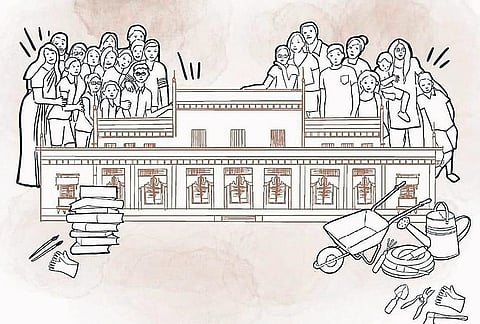
The MLS library flaunts a double-storeyed industrial structure, packing 76,000 books. The unique design of the 29- feet storage is such because it was created for the government officers at the time who used to wear big boots. While it was built by the British to store their books, the architecture was adapted to a more Indian look to gain public approval. Dull tones and muted colours gave way to Indian elements, such as jharokhas (overhanging enclosed balconies). The architectural details in the building have ensured preservation of the books for several years. The three levels of terraces built on the building allow a border of windows. These, in turn, ensure adequate diffused lightning, ventilation and circulation of dust, diminishing the need for constant air conditioning.
While the architectural details ease the preservation of the books, the staff is very diligent with their checks and book restoration as well. “The key factor because of which living heritage thrives, is conservation and regular maintenance. Cracks to the building are normal and MLS is stable. The challenge lies in how we’re preserving furniture and books. We ensure constant checking and monitoring. There’s a tabulation for the days when we check furniture or books. The thumb rule is to have a very clear heritage management plan in place. For MLS, with minimal finance, we make sure every care is taken,” Sevvel elaborated.
MLS has also added other details, such as high library stools and a book trolley. Additions are necessary to adapt a heritage site to modern technology, Seveel concluded.