
CHENNAI: The Carnatic music world is indebted to the immense contributions of the trio Tyagaraja, Muthuswami Dikshitar and Syama Sastri. Called the Trinity of Carnatic music, each musician had a unique approach to writing and composing music that has stood the test of time. Muthuswami Dikshitar, the youngest and eternal pilgrim, is celebrated among patrons and music connoisseurs for the meticulous descriptions of kshetras (temples) and deities in his kritis (compositions) during his lifetime (1775-1835). Despite the wealth of information left behind by him, there is no authentic documentation where one could map, visually and aurally, the kritis with the details present in them.
A project for posterity
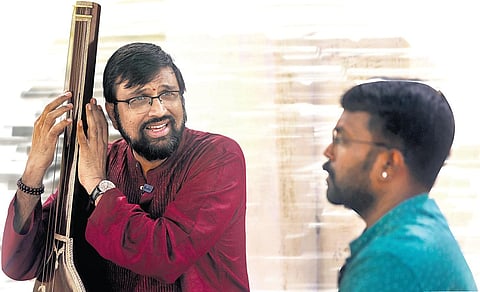
Dikshita Kshetra Darshanam by Guruguhaamrta is hoping to bridge this gap with its documentary series. The initiative was conceived by classical vocalist G Ravi Kiran, in collaboration with storyteller Madhusudhanan Kalaichelven. Speaking about the pandemic-birthed project, Ravi notes, “Dikshitar’s compositions lend themselves to myriad interpretations depending on what one seeks — his kritis could be viewed as musical edifices, spiritual outpourings, or travelogues. Through this project, we are trying to look inside out from a kriti to the context in which it’s set. The videos have been filmed at the kshetras mentioned in them. This project can kindle the interest of aspiring musicians and encourage them to explore some of his rare compositions that have not been touched even by seasoned artistes.”
The first season, comprising six episodes, will be released on a monthly basis. The 25-minute episode will offer a Dikshitar kriti sung by Ravi and elucidated by Madhusudhanan. The first episode premieres on March 24 and coincides with the 247th birth anniversary of Dikshitar. It features the Bhaktavatsala Perumal Kshetra at Thirukkannamangai, near Tiruvarur, and is supported by Indic Academy. “Dikshitar would’ve visited this temple during the 19th century at the peak time of the Maratha rulers who were great patrons of arts and architecture. He has mentioned the ten avatars of Lord Vishnu at the temple in his kriti. Surprisingly, there’s a Chola miniature panel depicting the ten avatars and it’s still intact. There’s also a large beehive located in the sanctum of Abhishekavalli Taayaar, and it is believed that the rishis in the form of bees offer worship to the deity. This also described by Dikshitar. He only drops hints for us to discover. To read or hear about these descriptions is one thing, but to have a first-hand experience was supremely divine and visually impactful,” explains Madhusudhanan.
A blessed opportunity
Dikshitar’s meticulous detailing of temples includes references to sthala puranam, the iconography, the details of the other deities, the kshetra puranam, the vriksha (tree) of the kshetra, the utsavams and the other architectural descriptions. “I rendered a live performance of his kriti with a manual tanpura at the temple. We were sceptical about the output quality, but the acoustic was beautiful. This is merely a passion project and not for commercial gains. Knowing our objective, the locals helped us a lot with the local lore. Our photographer Muthukrishnan M has added his magic touch to the visual elements to enhance the experience of viewers,” says Ravi.
In line with his sentiments, the trailer was launched at Ettayapuram where Dikshitar was laid to rest. In what came as a blessing to the duo, Madhusudhanan got to witness the grand wedding ceremony of Lord Vishnu and his consort Lakshmi at Bhaktavatsala Perumal Kshetra on Panguni Uthiram. “The wedding hall is well-maintained and similar to Dikshitar’s description of it in the kriti. The event took place with splendor and pomp. I requested the priest to play Dikshitar’s kriti sung by Ravi on the sacred occasion,” he recounts.
The music featured in the trailer is composed by K Arun Prakash. Beyond the likes and shares, the duo wants the series to highlight and propagate the legacy of Dikshitar. “We want people to be a part of this collective effort either by watching our videos or helping with funding our projects,” requests Ravi, who has been running Guruguhaamrta since 2009. For his part, Madhusudhanan assures, “This will be a digital library for reference. Documentation and publishing are key to preserving any object or building of historical importance. Dikshitar has done it many decades ago. Now it’s our job to bring it to the limelight and carry it forward. This is just the beginning.”
