
CHENNAI: 45 years ago, Kannan (fondly Padma Stage Kannan), migrated from Sivakasi to Chennai to pursue a career in Tamil theatre. While working at a hotel, he chanced upon a role in Vikramadithyan, a play by the late actor SV Sahasranamam. Little did he anticipate that to be a turning point. “I grew up watching SS Rajendran’s works and aspired to be an actor.
In the early days, I got to perform a few roles. But, subconsciously, I was always thinking about how the stage setting and decor could’ve been better. To an extent where Sahasranamam pointed out that I would be successful as a backstage technician,” recalls the Ice House resident, who has designed the stage for over 40,000 dramas, and, currently, has eight technicians working for him.
Work is worship
Like Kannan, the Tamil theatre fraternity has been welcoming to many aspirants who stepped into the industry with dreams of making it big as an actor but ended up carving a niche in various aspects of backstage management such as lights, costumes, stage settings and makeup. However, neither their awards and accomplishments nor enduring years of hardships and uncertainties prepared them for the biggest blow of the pandemic. Yet, here they are, crippling back to normalcy while battling mounting financial burdens and drastic drop in opportunities; all for their loyalty to the stage.
Mohammed Ibrahim, addressed as ‘Cheta’ Ravi on the sets, owes his life to theatre. “I started acting when I was a four-year-old in Kalaivanar NS Krishnan’s troupe. Those days, Muslims were not allowed to act in dramas. It was the late actor MG Ramachandran who called me Ravichandran. Then, while working with Radha Ravi sir, people addressed both of us as Ravi. The actor suggested that I tweak my name to ‘Cheta’ Ravi as I was from Kerala. I’ve studied only till class one; the stage has been my biggest teacher,” laughs Ravi, who has worked with the likes of Y Gee Mahendran, Crazy Mohan, Kathadi Ramamurthy.
Talents aplenty
While Ravi has dabbled with other technical skills like electricity, carpentry, painting, and stage work; his expertise lies in lighting; particularly for historical plays that posed a different set of challenges. “We used to have colour paper those days to show variation in lighting hues. LED lights have made life easier in recent times. I remember Y Gee Mahendran taking me abroad to watch Broadway shows. I was determined to bring some of the international techniques back home for our local audience. Affordability mattered a lot and we had to function within our budget. That’s where innovation and creativity helped,” beams the 63-year-old.
Another acclaimed lightman of similar calibre with a career spanning decades is Krishna or Kalaivanar Kitcha. With his two brothers, Kitcha manages Kalaivanar Oli Oli Amaippu Nilayam, started by their father S Paramasivam in 1956, and named after late thespian Kalaivanar NS Krishnan. With 48 years in the industry and having done the lighting for 7,500 shows, Kitcha highlights the creative process that goes into every production. “I picked up the tricks by accompanying my father to the sets.
Most of our ideas stem from collaborative discussions with directors. For instance, in an hour-long drama titled Manasa, there were 82 lights off scenes, and it was big for those times. Again, in the play Mazhai Uthir Kalam, natural elements like thunder, lightning and rain played a prominent role and we showed them effortlessly with lighting. In another play Nethra Darshinam, there’s a fire scene that happens at night and I pulled it off with just a red light and some smoke effects to replicate burning,” he says.

Old is gold
With relatively less funds, the technicians are combining old and new techniques to offer the best effect for the patrons. It’s all about learning through trials and errors, says makeup man Perambur Kumar. “I used to handle many mythological projects that demanded heavy makeovers. Some of the iconic characters I’ve created are Dakshinamoorthy and Mahaperiyava. The biographies usually traced the lifespan of the person, across various ages, all in one play. We had to dress the actor according to the time period. Again, makeup for black and white plays is different from colour. These days artistes do their own makeup and prefer light touch-ups. They prefer comfort. Makeup is a dynamic industry and we have to adapt ourselves to changing times and trends. I’ve learnt from some legends and I’m passing on my knowledge to the youngsters,” he opines. The salary those days was Rs 7 and every day (bata) was `25. While that has increased with time, it still does not suffice, he adds.
Seconding Kumar’s statement, makeup man TK Thangapandian chips in, “Ever wondered how a play beautifully unfolds in sequence? There’s meticulous work that goes into every scene. Particularly, historical plays of those days were executed at such magnitude. Artistes were dressed in ornate costumes. Just walking around in them would be cumbersome. But, these days, everybody wants minimal makeup and light clothing. Nobody wants to go the extra mile to look perfect for the time period. Pancake makeup and foundation is all that matters today. Even the number of scenes has come down from 70 to 40. We have no option but to cater to the latest demands.”
Changing times
With a significant drop in the number of shows, the technicians have been juggling multiple gigs to stay afloat. “Theatre is not profit-oriented. We work for satisfaction. Recognition from the audience is worth a crore rupees. Having said all that, we need to earn to run our households and that’s impossible if we count just on theatre assignments. Makeup artistes go to school functions, dramas and dance programmes to make money. Besides, we take up whatever job that comes our way. I have been whitewashing a few friends. There are hardly any technicians in the industry now and we end up splitting the work among ourselves,” shares Thangapandian.
While ‘Cheta’ Ravi, despite his expertise, has been forced to work as a night watchman at the Mylapore Fine Arts Club. “There’s literally been no work in the past two years. Some wellwishers helped us with money but that was too meagre to sail through. People refuse to pick up calls in the fear that we could ask for financial assistance and that’s disheartening. Gone are the days when we were treated with the utmost respect on sets. We were asked to eat before the actors. Directors would adjust their dates to work with us. Such was the value for talent. We were also recognised after every show for our work on stage and that has also gone down. The future seems bleak. My last wish is to die on stage while working,” says a teary-eyed Ravi.
The way ahead
Going forward, the technicians believe that the only way to keep the art form alive is in the hands of youngsters. “We used to have shows in the morning, noon and evening every day. It was so packed that we requested it to be spaced out. There were many active sabhas and members contributing to the growth. All that has come down with only a handful of sabha members left. We’re crying for two or three shows a month. The generation after us doesn’t see a future in this industry. That said, there’s a promising scope for younger talents and we’ve been seeing youngsters attending some of the shows. We’ve set the bar high,” says a hopeful Kitcha.
As a momentary respite, the technicians are currently preparing for the much-awaited Kodai Nataka Vizha that’s set to take place in May 2022. “I’m designing the sets for six troupes in the drama festival. Prices have gone up due to inflation. I have properties loaded in ten lorries and over a crore costumes accumulate over time. It would be great if the government recognises our efforts. Some of us technicians are part of the Tamil Nadu Iyal Isai Nadaga Manram. But, we’re unsure about the schemes and benefits that we can avail as part of this. From getting a membership to a pension, every process is daunting in this system. If only the government could look into this and bring a structural body, we would benefit a lot,” requests Kannan.
Against all odds, the technicians continue to pin their hopes on the art form that transformed their lives, personally and professionally. But, only time will tell how long they can keep the curtains up.
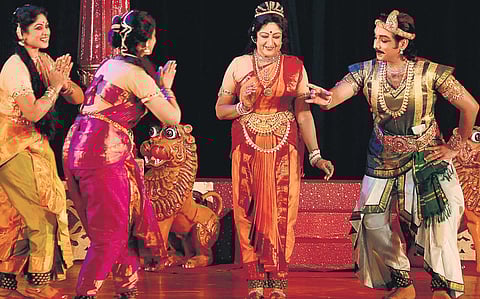
Seasoned technicians of Tamil theatre throw light on their reverence for the stage, the vital role they play in pulling off productions and their plight during the pandemic, ahead of World Theatre Day (March 27)