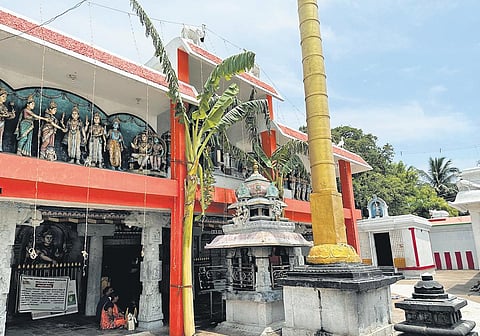

CHENNAI: Ilayanar Velur, also spelt as Ilayanar Vellore is a small village on the banks of River Cheyyar, a tributary of RiverPalar, about 20 km from Kanchipuram.
According to the Sthala Puranam (traditional story) of the Kadambanatha Svami temple in nearby Kadambur, Muruga, also known as Kadamba (since he wears a garland of Kadamba flowers), was sent by God Siva to protect rishis (sages) in this area from two demons named Malayan and Makaran. Muruga killed the demons and constructed a temple for Siva here.
The deity hence came to be called Kadambanatha Svami (Siva who was worshipped by Kadamba) and the place as Kadambar Kovil. Siva asked Muruga to settle down close by and he did so in Ilaiyanar Velur and the temple for Balasubramanya Svami is where the vel (spear) he threw at the demons landed after killing the demons. Arunagirinathar, the ardent devotee of Muruga, who lived in the 15th century A.D. had visited this temple and praised the deity in his famous work Thirupugazh.
The Ilayanar Velur temple has a tall five-storey on the east which has sculptures of the river Goddesses — Ganga and Yamuna — on either side as devotees enter the doorway. To the right of this gopuram, on the inside, is the utsava-mandapam where the deities are adorned before being taken out in procession. The temple has a wide outer prakaram (enclosure) with the bali-pitham, dvajastambham (flag-post) and a small mandapam enshrining an elephant which is the vahana (mount) of Balasubramanya Svami.

It is well-known that the peacock, the vahana, is the vehicle of this deity, but in a few temples, the elephant is also there. Incidentally, in several places on the compound wall of this temple also, the elephant vahana is seen.
Further into the temple is a large mandapam with two huge dvarapalakas (door guardians), which leads to the principal sanctum. Balasubramanya Svami is in a standing pose. His lower right hand is in abhaya hasta, blessing devotees, while the left hand is in uru-hasta, resting on his thigh. In his upper right hand he holds the japa-mala (garland of beads) and in the upper left hand is the kamandalu (water-pot). His powerful weapon Vel, rests across his chest. The utsava-murtis (processional images) are immediately in front of the main sanctum.
It is well known that the consorts of God Muruga are Valli and Deivayanai who are usually seen flanking him.
However, in this temple, Balasubramanya Svami’s consort is called Gajavalli (this name is a combination of Valli and Deivayanai). Yanai in Tamil and gaja in Sanskrit means elephant. The actual image of this Goddess, enshrined in a separate sanctum, is a syncretic form of both Muruga’s consorts. In the inner prakaram of this temple are enshrined Muruga with Valli and Devayanai; Lingas worshipped as Ekambaranathar, Sriperundanda Udaiyar with Tripurasundari and Kasi Visvanatha; Nritta Ganapati and Velayudamurti. Incidentally, the Vel, the powerful weapon of God Muruga is itself worshipped as a deity here. The outer prakaram has sacntums for Dakshinamurti, Varasiddhi Vinayaka, Goddess Durga and Navagrahas.
Many festivals are celebrated here, the most famous being the Brahmotsavam (annual festival) in the Tamil month of Chittirai (April-May) for ten days starting on Mrigasirsha Nakshatram. During the Visaka nakshatram in the month of Vaikasi (May-June), abhisekam is done with 1008 shanka (conches). Other festivals include Kritika nakshatram in the month of Adi. This place is also the Jiva-samadhi of many Siddhars.