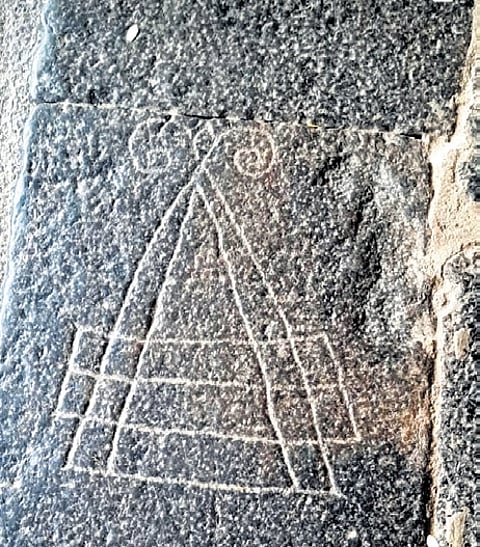

CHENNAI : In the last column, I wrote about the game of Dahdi which is seen engraved on the floors of numerous floors around Tamil Nadu but not recognisable as a game in this state.
I had a mail from Mr GP Shekar, an ardent enthusiast of markings/engravings in temples, especially what appear to be games, who found the article very interesting. He shared the image of a game of Aadu Puli Aattam (tiger and goat game) found in the Nitya Kalyana Perumal temple at Thiruvidanthai near Chennai. Note the personalised embellishments that the person has added to the basic board. It speaks of fun and enthusiasm as well as the skilled hands of a craftsman.
He says, “Imagine, some centuries ago, visitors may have played this game leisurely (may be seriously too?) at the temple. While the temple is just off the ECR, the surroundings still take us back by several centuries (though several buildings have come up over last decade). With backwaters and the sea nearby, there must have been dense foliage with lush green forest. Playing Aadu Puli Aattam here must have been great fun!”
Playing Aadu Puli Aattam was undoubtedly popular in Tamil Nadu. Played with three tigers and fifteen goats this hunt game pits the apparently weaker goats against the tigers. The tigers try to kill the goats and the goats in turn try to surround the tigers and block them from moving. This game was apparently so popular that there are spaces in Chennai where multiple boards are etched on the floor in close proximity to one another.
But it is not merely in Chennai that this game is popular. Both in this version as well as numerous other versions with different game grids, and a varying number of tigers and goats, people have played this game across the country. During a recent trip to Odisha, I watched two people play the game on a square grid with four tigers and twenty goats. Some rules vary but the concept remains the same.
What makes this game so fascinating is its asymmetry. At first glance the two sides look uneven unlike standard strategy games like chess which has both sides evenly matched. However, although the tigers and goats have different number of game pieces, different moves, and different goals, when it comes down to game play, they are evenly matched.
These games are often described as hunt games as one side tries to hunt down the other. What you cannot do in Aadu Puli Aattam is sacrifice a game piece, because every goat you lose weakens you. Unlike Chess, to stretch the example, that was born and played in the palaces and homes of kings and zamindars, Aadu Puli Aattam is a testament to the community.
Here is a place where individuals not only have to work together but also support each other leaving no one behind in an effort to succeed. This is not just about teamwork, for the word teamwork, however popular it may be today, simply means working together.
The concept of Aadu Puli Aattam goes beyond that. It is about protecting each other from the metaphorical tigers and ensuring that all individuals are safe for each one lost weakens the community. Truly wonderful lessons for our current times in a simple peasant game etched on the floors of temples and monuments.
Vinita Sidhartha
vinita@kreedagmes.com
The writer is an author and the founder of Kreeda, an organisation reviving traditional games
