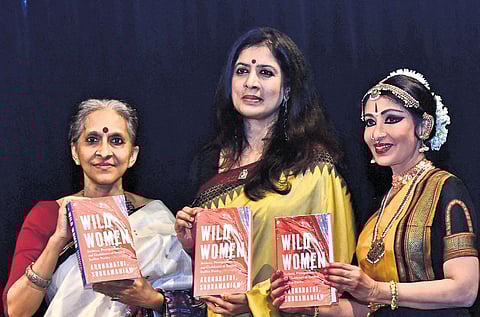

CHENNAI: On April 29, 2019, Arundhathi Subramaniam curated ‘Wild Women’, a multi-arts concept focussing on the feminine. It was a celebration of poetry and performance of women who charted their spiritual journeys. Following this event, she began to seek more into the space. Five years later, ‘Wild Women’ is now a book. “As a thirsty seeker, I have been energised by many male mystic poets.
They have come to my rescue when I was in need. But the question remained where are the women? It felt like this lacuna needs to be desperately addressed,” says poet and author Arundhathi. She advanced the curation into an anthology of sacred poetry, launched at the Jaipur Literature Festival in February this year. Wild Women: Seekers, Protagonists and Goddesses in Sacred Indian Poetry brings together the voices from around the country that are about, for, and by women.
Tracing the pages
The book was shaped over five years for all those who want to read “about women’s importance, blood, hunger, hormones, appetites for life and deeper life,” she says. It was launched in Chennai by Carnatic musician Bombay Jayashri Ramnath at event hosted on Saturday by Alarmel Valli’s Dipasikha Dance Foundation in collaboration with Alliance Française of Madras. The creative collaborator of the event was Aalaap.
Compiling the book was a task indeed as half of the content — more than 150 poems — are new translations. “We started with 20 mystic poets and at the end of every proof stage, we kept adding more and more. I kept going because of these women as their poems pulled me back,” she shares. What started as a “pleasurable sense of anticipation” working on the texts, ended in relief when the book took its final form. “When I look at it despite all the roadblocks and the traffic snarls on the way, I feel that this journey has reached a culmination that I can stand by,” she adds.
Through the journey, Arundhathi understood that there is a living heritage waiting not only to be uncovered but also to be invented and improvised. She says, “There is a thirst that we all carry which is more inclusive, less skewed, less hierarchical, less lopsided heritage of culture and spirituality and it is a shared thirst.”
Decoding the book
The male poets channelled their inner female voice and created strong, tall, and powerful female protagonists who are unwilling to batter their freedom for social respectability. Poets like Jayadeva, Narasinh Mehta, and Annamacharya addressed God more intimately. “Women spoke to her lover (God) with great familiarity. For example, Alamelu Manga says, He (God) is my slave. With this we are entering a space where you do not know who has the upper hand — the men or women or the divine or human,” notes Arundhathi.
These poets tell you that there are no ready-made answers on the path (spiritual life) and are giving you spirited ways to live with uncertainty. “There is no way to make a journey home without acknowledging the body. Our body is an instrument and not an impediment, it is the basis of the journey and not a barrier,” she narrates.
Explaining this, Arundhathi says the 14th-century Dalit mystic poet Soyarabai looked at her naked body and asked “If menstrual blood is impure then tell me who wasn’t born of that blood?”. Meanwhile, Avudai Akkal’s poems from the 18th century raise questions about menstruation and saliva. “The very child is born of the intermingling of the bodily fluids of parents. Is the child also impure? If that is the case then all of creation is impure”.
“These poets are asking us resonant questions that sound crazy and wild even today. These are the questions that need to be asked as they do not allow us to settle for easy orthodoxies,” says the author. Adding that we live in a conceptually fragmented world that makes us believe that it is men vs women, Arundhathi says, “The poems remind us that the material and the metaphysical are not at war, that the sexes are not engaged in a battle but in fact seen as a festival…The man, who is the man? The woman, where is the woman? You don’t know where one ends and the other begins.”
A seeking that never ends
So, in the book’s preface, Arundhathi writes, “When we hear of them, it is invariably as plaster saints or meek followers. It is time to smell the danger in their words again, to listen to their feral sensuality, their searing questions about custodians of gender and faith. It is time to tune into their brazenness, their heartbreaking longing. Not just for their sake but for ours too”.
In order to mark the end line somewhere, the book was divided into three chapters; the first one is titled Mystic, Seekers and Devotees, which contains 56 women poets; the second is Men as Women poets with 14 men, and the third, Goddess With Poems, on Goddeses.
Arudhathi believes that the book is to be read by people of all “persuasions” because the women in the book are pushing boundaries in all manners. “Seekers of all kinds who are willing to be surprised; the book expands the understanding of the sacred. The sacred is not a preserve bunch of preset pandits and cultural gatekeepers but can be found wherever we choose, even from within. Additionally, this poetic book shows the rich female ancestry we have,” she notes.
To explain the book in the words of the author: The book is a thali, where each dish, read poet, gives a fresh and new flavour to your taste buds. The more dishes (poets) you explore, the more you savour.
‘Wild Women: Seekers, Protagonists and Goddesses in Sacred Indian Poetry’ by Arundhathi Subramniam, published by Penguin Random House is priced at Rs 999. It is available online and in bookstores.