
The Banyan, much like the ancient Yggdrasil, does not merely grow, it connects. Rooted in memory, branching through time, it stretches across the now and into what comes next. This tree is culture and art.
On a sultry Sunday afternoon in Backyard, Adyar, this idea came alive in form. The third edition of The Living Library of Artists, hosted by The Sunshine House, transformed the space into a living, breathing archive of queerness, craft, and cultural memory.
Unlike the white-walled ‘chicness’ of traditional galleries, this was art as an encounter. Artistes stood beside their work on display inside the two-storeyed building, not just to be observed, but to be spoken with. “Think of this as a library,” said Purple, one of the curators of the event. “You talk to an artiste. Each of them will have a story to tell. Each of them is growing, like branches of a tree, and each one gives a hand.”
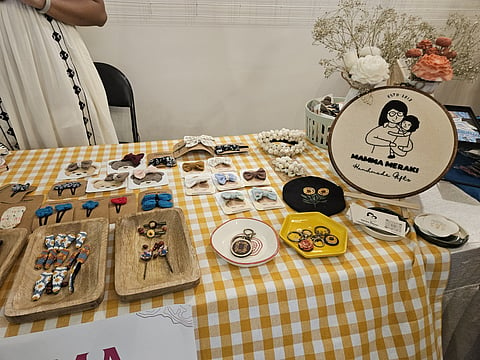
For the past two years, The Sunshine House, founded by John Faust, watched this tree grow in height, and in depth. This year, more than 20 artistes participated — sharing comics, crochet, music, clay, digital illustration, and deeply personal stories. Small stalls lined the paths — Red Eye Chapter, an indie comics bookstore; Biba Crochet with vibrant-toned threadwork; The Clay Tribe’s clay utensils; and so on.
In one corner, Urban Sketchers Chennai quietly drew the scene, capturing the visual poetry of performers and passers-by. As the light shifted, a panel titled Out of the Closet, Onto the Canvas gathered a crowd — an open conversation about queerness and its growing visibility in the Indian art world.
“There is still a barrier,” said Devam Sinha, a dancer and panelist. “Sometimes I wonder, does the agony we feel even reach the audience?” They spoke of drag, often misunderstood, often erased. “History has been amended to suit narratives. There have been men who have been dressing up as women and performing Koothu. But when it comes to drag, we treat it like a separate idea. Even drag shouldn’t be restricted to men. Queer history has always been in our art forms — even when it’s unnamed.”

Riya Nagendra, a comic artist whose zines blend satire with social commentary, drew the link between city life and queerness. “I focus on observing the people around me. It’s so nice to observe queer artistes around. The cool thing about being queer is that we gather together with each other. In the art we can still look at each other despite the difficulties,” they said.
Their sketchbooks carry glimpses of the city — fragments of fictional characters, overheard dialogues — all refracted through a queer lens. “I feel like comics and queerness sit in the same place in the city. They both are visible, but still somehow on the fringes,” Riya added.
For many, the event wasn’t just about showing work but about having a space to exist fully. Harish, who has worked across theatre and visual art, described Chennai as a city that is both “deeply queer and deeply conservative.” He added, “There is a huge absence of experiential queerness. That’s why spaces like this matter. There’s no one way to be a queer artiste. Everybody has a unique story and journey. We can just be as small or as big as we want.”
Sri, a Bharatanatyam dancer who now experiments with visual patterns and stickers, spoke of how her art has evolved. “It used to be just movement. Now I see shapes everywhere — in dance, in design. It’s all starting to blend,” she said, pointing to her painting of a Bharatanatyam dancer in a costume made of roses. Representing regional comics, Sumi, founder of Red Eye Chapter, spoke about the event’s inclusion of artistes like her and said, “It’s important that we don’t just sell books, we amplify voices.”
For the branches to keep growing, the roots must be nourished. “We want artistes to earn, so they can return to their art,” Purple said, sharing that the Sunshine House will continue to be a platform supporting queer and independent artistes.