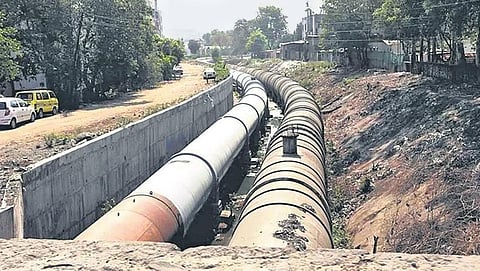

CHENNAI: The ambitious plan of Chennai Metropolitan Water Supply and Sewerage Board (Metro Water) to deploy robots to detect leaks in underground water and sewer pipelines has hit a roadblock as the ‘Water Manager’ could not find any qualified firm to provide and operate the robots.
A Metro Water official, privy to the development, said a tender was floated in January inviting eligible firms to provide the service. “A few bids were received. Upon scrutiny, it was found all the firms that submitted bids did not meet the eligibility criteria,” the official added.
Further, the official said a fresh tender has been floated hoping for widespread participation from the eligible companies. At the same time, Metro Water did not relax eligibility criteria in the re-tender process.
Without disclosing the number of bids received, the official explained the robotic technology for pipeline maintenance is a new technology and there are not sufficient options in the market to choose from. “Re-tender has been floated to attract more competition. Bids will be opened and the work order will be issued after the election,” the official added.
As per the plan, RoboCam, Robo90 and Robo250 devices would be deployed to enter the pipelines that are impossible to enter and inspect manually. The project will be implemented at a cost of around `2 crore.
The scope of work includes identification of contamination source, leak detection, improper joints, illegal connections (ferrules), encrustation level and other anomalies in the water pipeline size range from 100mm to 500mm diametre. Once the bidding process is over, the selected firm have to operate the robots for two years.
RoboCam can reach a maximum length of 100m inside the pipelines and can be used in water and sewer pipelines. On the other hand, Robo90 can reach up to 120m and would be mostly used in water pipelines. Robo250 can reach up to 250m to 300m inside the sewer pipelines. The robotic cameras would provide live feed of the visuals inside the pipelines.
Apart from using robotic equipment, the Metro Water would utilise Artificial Intelligence (AI) to identify defects in real-time based on the feeds provided by the robotic cameras. Based on the date provided by robotic equipment and AI, the Metro Water will carry out rectification and prevention works.
