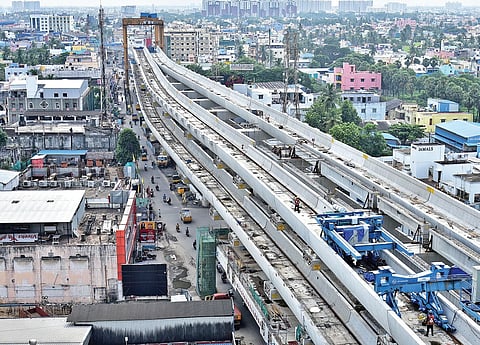

CHENNAI: A key 12-km stretch between Koyambedu and Chennai Trade Centre-part of Corridor 5 (Red Line) under Phase II of Chennai Metro Rail Limited is under pressure to meet its June deadline, as a shortage of migrant labour has slowed down the final stages of construction.
On paper, the project is nearing completion. Civil works have largely finished, with overall progress estimated at around 75%. However, the remaining tasks — station access points, entry and exit structures — are proving more difficult to execute. These finishing works are labour-intensive, and the available workforce has thinned sharply in recent weeks, said officials.
A large share of workers has returned to eastern India for the West Bengal Assembly election, a cyclical disruption that continues to affect infrastructure timelines across the country. “We currently have around 400, against a requirement of 800,” a Chennai Metro Rail official said, adding workforce levels are expected to normalise only by mid-May.
Eight of the 12 stations along the stretch have been affected, including Koyambedu, Green Market, Natesan Nagar, Virugambakkam, Mugalivakkam, Ramapuram, Manapakkam and Chennai Trade Centre. In contrast, work at four double-decker stations is on schedule due to relatively better labour availability.
The divergence within the project is notable. Core engineering work, such as viaduct construction and track-laying, continues largely on track, supported by a more stable workforce of around 1,500. The slowdown is concentrated in the final, labour-heavy stages.
The Koyambedu-Chennai Trade Centre stretch also features double-decker sections designed to ease congestion along key urban corridors, with progress on these components proceeding as planned, the officials added.
