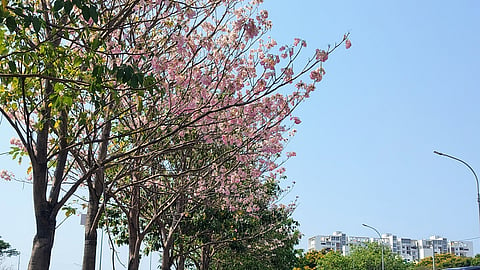

A few days ago, Chennai was blushing pink. Covered in a canopy of flowers that almost look like cherry blossoms, the colour pink spread across neighbourhoods, catching everyone’s eye. Petals fell softly onto the pavements and roads, and the branches slowly swayed with the summer breeze. Across the city, along roads from Maduravoyal to Old Mahabalipuram Road (OMR), people paused mid-step, mid-drive, gathering to witness the sight of the pink trumpet in full bloom. For many, it was a surprising break from Chennai’s usual summer palette, turning familiar streets into sudden bursts of pink. Now, the bloom is already beginning to fade, but not the memory.
Having newly moved to Chennai, Vinod Kumar says this was his first time experiencing the blossoms. “I only saw it in movies. It felt like a dream. I felt so calm and happy… like the whole place became even more beautiful,” he says.

The sight came unexpectedly during daily commutes for a few. “This (Maduravoyal) is my regular route from home to office, so I happened to notice it while passing by,” says Uva Krishna, a Chennai-based content creator. Others discovered it through social media posts that quickly drew attention to the various stretches.
While many in Chennai are noticing the blossoms for the first time, they are not entirely new to Indian cities. Seen in places like Bengaluru and Coimbatore, these trees have long drawn attention. “I have never noticed them in Chennai before. Since I love flowers and adore seeing them in clusters, I travelled to Bengaluru for a day just to see the pink flowers,” says Diya. “I went to Cubbon Park and found a single tree. I was so happy with it that I sat under it for a long time. Later, when I went for a walk, I found more trees in another nearby park, there were a whole bunch of them. I sent those pictures to my friends, telling them that my quest of finding pink flowers in Bengaluru in December was successful.”
For those who witnessed it at its peak, the shift was hard to miss. “The entire stretch looked beautiful, with trees fully covered in pink and white blooms. It almost felt like a different city,” says Uva. Many stopped to take photos and reels, while others simply paused to take in the view.
Passing cloud of pink
The bloom comes from Tabebuia rosea, commonly known as the pink trumpet tree, an ornamental species native to Central and South America, with a range extending from Mexico to Argentina. “Most of the flowering trees in India are native to the tropical American region and some are native to Africa. Since the trees are from these tropical regions they adapt very well except for the want of proper pollinators,” explains D Narasimhan, former professor of Botany, Madras Christian College.
The tree typically flowers during the drier months, often between late winter and early summer, when it sheds most of its leaves and bursts into clusters of pink, trumpet-shaped blossoms. Explaining the science behind the growth and flowering process, S Nagaraj, assistant professor, Centre for Advanced Study in Botany, shares, “These trees usually take three to four years to attain the stage of blooming. It falls under the zero fighting trees that have adapted to survive in environments with little to no water. They thrive in drought-like conditions.”
Known for its brief blooming cycle, the flowers usually last only one to two weeks, depending on weather conditions, before they begin to fall rapidly. Explaining the shedding and maturing, Shobha Menon, founder trustee from Nizhal, explains, “Studies have indicated that for every 1degree Celcius of warming, trees may flower 2.5 days earlier. However it is not ideally suited for coastal cities since it is vulnerable to high winds and can fall easily during cyclones.”
These pink trumpet trees are primarily planted to soften the glare from oncoming vehicles, but one can assume that it has added colour to our pollution-filled city roads and highways. Narasimhan points out, “People should be watchful during rainy and cyclone seasons as they (the trees) do not have a deep rooting system and mostly surface feeders. They could be easily dislodged. It is one of the common trees in Chennai that falls during cyclone seasons.”
This common tree was previously seen only in specific parts of the city. This year, they have spread out across Chennai — from OMR to Maduravoyal, Adyar to T Nagar, and Pallavaram to Anna Nagar — garnering attention from most Chennaiites online and offline. Shobha puts forth her thought on this sudden notice, “This year it has been more profuse and more visible. Flowers are always beautiful and it is easy to feel emotionally drawn to them particularly in our chaotic city life. Social media does add to the hype. So even those who aren’t there, by nature don’t want to miss out on the excitement.” Adding to the conversation, Narasimhan says that we are attracted by the colour. “Aesthetic value dominates the functional value,” he notes.
From being few and far between to now flourishing across the city, these trees have to be researched more to understand if they have a role in indicating climate change. “We need long term data, of at least 100 years, coupled with climatic data,” he explains.
Certain things are meant to be cherished only while they last, even if only for a brief moment. And just like that, the pink blossoms have begun to wither. The flowers are slowly losing their colour and falling away, leaving the branches standing bare.
At stretches like Maduravoyal, once widely shared online, the flowers now lie dry and scattered, the canopy already thinning out. “That’s the beauty of it. It blooms for a certain time, waits for no one, and moves on. Much like everything in life,” says Diya. For a few brief days, it was enough to make a fast-moving city pause and look up.