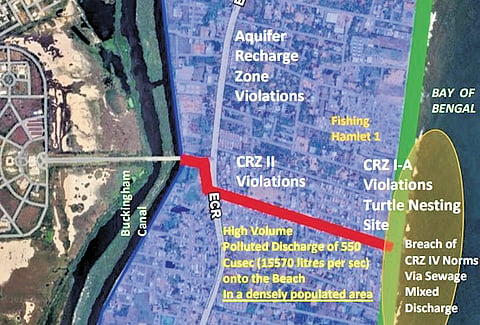

CHENNAI: The residents of VGP layout in Uthandi and fisherfolk from Nainarkuppam have urged the Tamil Nadu State Coastal Zone Management Authority (TNSCZMA) and the Ministry of Environment, Forest and Climate Change not to approve the proposed 1.05-km cut-and-cover flood drain project by the Water Resources Department (WRD), calling it “non-viable” and environmentally damaging.
The project, estimated at Rs 91 crore, aims to address flooding in low-lying areas around Pallikaranai marsh by increasing the discharge capacity of the Buckingham Canal (B Canal). Currently, peak outflow from the marsh is 8,560 cusecs, and via Okkiyam Madavu, it reaches the B-canal, which could handle only 7,063 cusecs. The proposal includes a 1,050m underground macro-drain from the B-canal to the Bay of Bengal at Uthandi, aiming to increase the discharge capacity by an additional 550 cusecs.
In a citizen’s report, the residents noted the WRD’s Coastal Regulation Zone (CRZ) application mentions only CRZ-II norms, omitting CRZ-IA and CRZ-IV classifications. The proposed discharge point to the sea is identified as an Olive Ridley turtle nesting site and falls within an ecologically sensitive CRZ-IA zone.
WRD, in its official report, indicated there were 365 sewage outfalls in B-canal as of 2022, and another 10 were added by 2024. Independent testing by CUBE (IIT & TN government) found faecal coliform levels at 1,600 MPN/100 ml — 16 times the permissible limit, and biochemical oxygen demand at 26.5 mg/l, nearly nine times the standard.
This means the canal would release 550 cusecs of sewage mixed outflow, equivalent to about 78 tanker loads/minute, directly on to the beach, a clear violation of CRZ norms. WRD has also admitted there is no provision to treat them at present, the report said.
The residents warned that the project would affect the aquifer recharge zone — one of Chennai’s last remaining critical groundwater buffers — as the discharge could contaminate groundwater in the area’s sandy, porous terrain. It may also disrupt the natural percolation and reduce aquifer recharge, permanently impacting drinking water sources and turning them salty.
While WRD itself cited silt buildup in the B-canal, along with tidal surges during cyclones and encroachments, as reasons for its reduced discharge capacity, the residents urged WRD to work on them instead.
“We suspect that more such straight-cut channels will be proposed along the aquifer recharge zone as new encroachments in the Pallikaranai marsh continue. This should not be viewed as a single project,” said Sai Lakshmi, a resident of Uthandi.
Nainarkuppam’s fishing community, engaged in shore seine fishing, located within 500m of the outfall, said polluted water may damage nearshore ecosystems and reduce fish availability, directly affecting their livelihood. While the preliminary work on the project began last year, the project is currently suspended as it did not get CRZ approval.
