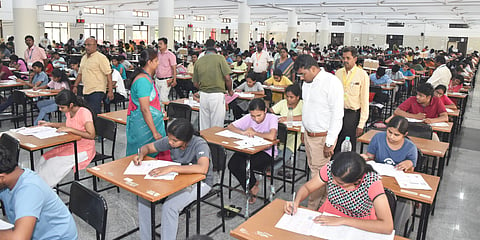

Princy*, a first-generation learner who appeared for NEET (National Eligibility cum Entrance Test) re-exam, was hopeful about her results. “I will pass this time,” she told her brother AR through a call. When she went home, her dreams were being erased by her parents. Because of the delay in exams and the uncertainty, they wanted to marry her off and gave an ultimatum. With no alternative, she tragically ended her life. “If she were still at home today, she would be happy. I do not want any other student to struggle like her,” AR said at the CJP Protest at Balan Illam, T Nagar.
Students lose their lives to an examination. They lose years to repeated attempts. A family spends lakhs on coaching, books, travel, and accommodation. For first-generation learners, especially from rural and Tamil-medium backgrounds, the hurdles are more. They must learn the rules of an unfamiliar system.
Want v/s need
Every classroom holds two kinds of student stories. Those who follow their dreams and the others, whose dreams are often negotiated or decided by circumstances. In Vishwa Kamalraj’s case, it was the latter. He wanted to be a historian. But his father wanted him to become a doctor. “Since he was paying for my education, I thought it would be best for me to have a career of his choice. 15-16 vayasu paiyan sonna yaaru kepa?’ (Who’d listen to a 15-16-year-old boy) ?” asks Vishwa, an alumnus of Government Higher Secondary School, Thirupulivanam.
He drained himself in NEET coaching. His parents were under the assumption that passing NEET would make their son a doctor. “For them, NEET was like any other government exam, which you pass and secure a job. My parents did not have the awareness that NEET was for college admissions.”
In contrast, Sangeetha V, now a nursing graduate, had aspired to pursue MBBS. Her family offered neither support nor opposition. She attended coaching classes offered during the weekends at her school, adding an extra two hours of study time every day, decoding and understanding concepts — and watched the seeds of her dream finally bear fruit.

The language hurdle
When RPS Matric HSS in Uthangarai offered free NEET coaching for a month, Nandhini Venkatachalam joined the classes. The academy separated Tamil-medium and English-medium students into different batches, but she was told that preparing in English would help her. She spent extra hours learning English terms for everything she could conceptualise in her mother tongue. She explains, “Terms like muthukelumbullavai and muthukelumpattravai resurfaced as vertebrates and invertebrates. It took me more than a week just to understand what they were initially teaching in class. Every evening I used to go back home, type the unfamiliar words into my phone, search for their meanings, and check them against my old school textbooks. I had to work two or three times harder than a regular student.”
The language barrier ran straight into a financial one when her coaching centre included NCERT textbooks. She could afford neither an English set nor a Tamil set and instead prepared from her TN state board Class 11 and 12 textbooks. She says, “Around 10 or 15 of us took the examination, and none of us could pass as we could not understand the questions.”
The hardship of thinking of an answer in Tamil, and recording it in the Optical Mark Recognition (OMR) sheet was explained by Sangeetha. “Most questions, especially in Physics, were application-based which were hard to understand and answer. Nearing the end of exam, I answered without even comprehending. This also infused the fear of negative marking,” she says.
The continuing cost
V Sanjay, a student of Anasthesia, away from home, says the expense of medical education can be difficult to sustain. “When we are studying in UG, a lot of first-gen learners make use of scholarship opportunities.” To escape the cycle of financial uncertainty, many students begin earning at the very first opportunity, often putting their ambitions on hold. Having not cleared the exam in the first attempt, Sangeetha detoured. “My teachers asked me to prepare and appear for the exam the following year, but losing one year towards preparation would mean letting go of 12 months of paycheck which could support my family,” she shares. Eventually, her family took out a loan for her to complete BSc Nursing and she has been working for a year now.
A gender divide
Time, language, and money do not guarantee access. Sanjay says gender also plays a role. The families of five girls from his batch did not give them another chance, he says. Nandhini his sister, describes the same divide at home. “At home, people say, ‘He is a boy. Let him study and then work.’ But when it comes to a girl, who spends four years preparing for NEET and then MBBS, people start asking, ‘What are you doing? How long are you going to keep studying?’ They bring up marriage. Because of this, even girls who perform well in NEET and have a good chance of getting a MBBS seat may not be able to pursue it.” Nandhini eventually joined BSc Zoology at Presidency College. She still wonders whether another year might have given her a different result.
For fair NEET
Despite everything the siblings encountered, neither asks for NEET to be abolished. Nandhini justifies, “Before the introduction of NEET, the affluent might buy their admissions.” But what troubles her is the current state. “After Covid, NEET preparation became a business. Attending coaching classes costs one or two lakh rupees,” she says. Her demand is for free coaching and for NEET to be conducted, as she puts it, “in the fair manner in which it was originally intended.”
Sanjay concurs, “If NEET is conducted transparently, and students from government schools are given the necessary support, they will be able to crack the exams and secure seats.”
For ban NEET
Understanding the systemic discrepancies, Vishwa and Sangeetha vouch that NEET should be banned completely. Vishwa says, “I would always prioritise my state’s autonomy — Tamil Nadu has a wide medical infrastructure for which native students should be eligible.”
According to him, decentralising power would also mean that students from respective state board syllabus will have the same starting line to reach the end goal of becoming doctors. He also addresses the systemic loophole in this issue — corruption. “Yes, corruption will still be a major part of admissions then, but at least all the students will have an equal opportunity to apply in state-owned premier, well-structured, and extensive colleges, because it would happen based on the marks scored in their state board finals,” he explains.
Sangeetha has a more human-centric view. She says, “This exam forced me to push away my dream. Like me, a lot of others are also compelled to pursue a different career, and many even lose their life. If not for this test, those souls would be walking on this earth today, may or may not be living their dream of becoming a doctor in reality. At least they would have gotten a fair chance at it,”
The cause for this conversation roots from the lack of equal opportunities in the industry, majorly. In the words of BR Ambedkar, “Equality may be a fiction but nonetheless one must accept it as a governing principle,” emphasising equality as the essential foundation for education. When the ground is uneven to begin with, aspirations do not have the ability to fight the system.
*Name changed