
The monstrous exam has claimed lives, students are in the throes of anxiety, coaching centres are devouring piles of hard-earned money, and families are burried under debts. Tamil Nadu’s anti-NEET sentiment reflects resistance from fringes, from the oppressed. There is no compensation for students who feel “double burden” of studying both state syllabus and NCERT, no heed paid to the sacrifices a Tamil-medium student makes, no record of how much families invest, and no scrutiny on how coaching centres function. “NEET is the greatest corruption of all times,” as educational activist, PB Prince Gajendra Babu puts it. The bottomline, in any which way we connotate this is: Students are still reeling from NEET atrocities.
From classrooms to the discrimination in coaching centres followed by years of trials and tribulations, medical entrance has become a nightmare for many. And there is no justification for placing the same yardstick for students from diverse educational and socio-economic backgrounds.
Personal struggles
Ragul K from Krishnagiri did not know the first thing about this examination until he was in class 11. Even a year after NEET’s inception in 2017, it hadn’t caught on in state schools. When admissions were based solely on the higher secondary marks, Ragul says, his school had produced many doctors. His mother wanted to see him as one too. But his teachers were unaware of study materials to suggest students. “They ended up recommending over 50 books,” he says. After appearing for the exam in 2019, Ragul realised that NEET would be a far-fetched dream if he didn’t go to a coaching centre. His mother, the sole breadwinner, who earned by ironing clothes, poured her entire savings into coaching, which cost Rs 3.5 lakh.
The coaching centre in Vijayawada took only boarders. Revisiting those years away from home, Ragul can only recount the discreet politics at the coaching centre and strained relationship with his mother as conversations always revolved around marks and comparisons. He learnt it the hard way: “Efforts don’t count. Only results speak.” The struggle of comprehending the subject continued in the rigid coaching classrooms where, he says, teachers wouldn’t touch upon the basics as students were expected to be well versed at it. Trainers were from north India and classes were either held in English or Hindi, and communication eventually became a quiet struggle for him. Despite being caught up in the cobweb of hardwork and result-oriented learning systems for three years, he did not change course. “It felt like I was betraying my mother’s dream.”
High scorers go as repeaters whereas low scorers go to private colleges. NEET sustains people who have got money.
PB Prince Gajendra Babu
What do those students do who have no means of knowing what to study for NEET? “How can we be compared with someone from Anna Nagar or Mylapore? We don’t even know what to study. Only after two years into NEET preparation, I learnt about the syllabus.” These words of Keerthi K, who studied in a government-aided school in Vyasarpadi, calls out the urban privilege. With almost no foreknowledge as she was one of the first students from her school and her family to appear for NEET in 2021, she passed the examination. But, eligibility wasn’t enough for her to get a government seat.
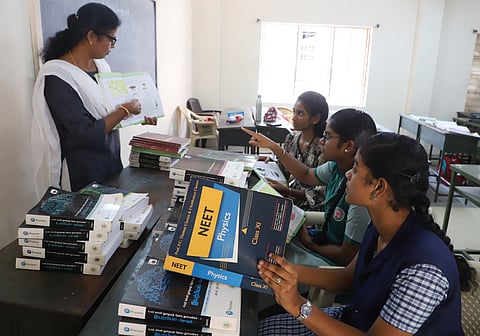
R Janci Mary, who travelled 40 km every day from Tattanpatty, a village in Tirunelveli, to one of the nearest coaching centres in Tenkasi, says that it took her almost five months to adapt to the classes. In a class with a whopping majority of English-medium students, language barrier was never a collective concern. “Only my friend and I were from Tamil medium. I would come home and translate what was taught in class. I couldn’t even clarify my doubts because my teachers were from Kerala and they taught only in English,” she says. The time for self study was never enough for her as travel took a major part of the day. She would leave home by 7 am and come back by 7.30 pm. Her father, A Raja Sekaran, a tailor, says, “Travel cost her around Rs 100 every day.” It’s not that Janci didn’t consider studying in a residential institute. Raja chips in, “There are residential coaching centres in Tirunelveli, but the fees would amount to Rs 3 lakh per year. We scrambled to even pay Rs 1 lakh.” Keerthi, whose father is an auto driver, says, “Students from well-off families can afford the lakhs of amount coaching centres demand. Here, we all are daily wage earners.”

Divide and teach
Coaching centres function on a scripted schedule. There are weekly mock tests and a hidden agenda behind them — to segregate the students and train them differently. Seventeen-year-old Thriambika, who devoted three years of schooling for coaching in Chennai, scorns that such an atmosphere of divide and teach makes the place even more hostile for studies. She protests the idea of spending even a day in a coaching centre. “Institutes are jails in disguise,” she says, adding that the coaching pressure broke open into her school hours too. “I don’t remember having lunch during breaks for almost three years. I never went out with my friends. I didn’t have weekends.”
While Janci has heard of this system being practised in coaching centres in Tirunelveli, Karthigha RK shares that a few months into coaching in 2025, they were segregated into different batches, too. The top-scoring batch formally had a name in Hindi, which, she says, translated to “victorious” or “winners”. “These top scorers had classes when others had week offs. And surprisingly, many students from this batch got placed.” Ragul mentions that tuition fees and discounts were also hinged on the marks the students got in the first attempt of NEET. “The students from the last two groups, mostly from state schools, ended up paying the entire fee.”
This segregation has become the foundation on which coaching centres operate. Prince says, “Coaching centres have different approaches. Heavy-fee collecting coaching centres follow a corporate model, where teachers are paid heavily. The teachers are trained in such a way that they should be able to make the students understand the MCQ pattern.” He notes that the segregation also happens on the basis of the parents’ and children’s needs. Affluent parents send their children to get the minimum eligibility marks, so that they can put them into private colleges. “Coaching centres adapt their own method of identifying and analysing the children. They train the top scorers and focus on them,” Prince says. Karthigha’s coaching centre holds an annual cultural event where chosen students from the “victorious” batch are felicitated even before the examination. When results are out, the toppers are lauded. She recalls an instance where a faculty stressed on a student’s caste reservation reminding her of her margin marks. Karthigha remarks that it’s not fair to use reservation as a means to cheer students. In a class with a majority of well-off students from English-medium, government school students are often reluctant to reveal where they come from, fearing judgments.
An exhilarating exit
Ragul, who is now a research associate with a biotech company, appeared three consecutive years for NEET but couldn’t make up to the cut off marks to get admitted in a government medical college. His affluent peers flew abroad and some joined private medical colleges. Thriambika, who has joined for B.Tech in Biotechnology, says the paper leak and re-NEET had dampened her hope of getting high marks and getting a medical seat. “The struggle feels meaningless.” While preparing for NEET in 2021, Keerthi also pursued a free allied course in MMC and is a cardio sonography technician now. Yet, she attended a free online course in 2025, and attempted NEET this year. She was close to securing a government seat but the re-examination has left her hanging. However, she is awaiting counselling. Janci, who continues to attend online classes, concurs that if the first exam was fair, she’d have gotten a government seat. Karthigha, however, considers herself fortunate for steering the path and not pursuing a career that would only leave a middle-class student stranded with hefty loans.
Paper leaks have not been a new issue. Each year, they hear about fraudulent cases and irregularities — the rich buying question papers paying lakhs, result discrepancies, incorrect questions and options. Keerthi draws attention to problems faced by students who opt for Tamil paper. “Questions are often loosely translated into Tamil. Certain terms are left untranslated.” None of these feels new anymore, they say.
Emphasising on Dr BR Ambedkar's words, "examination and education are two different things", Prince says, “We are asking to strengthen education, but some educationists are making examination tougher.” These scathing remarks echo the angst of students who are laboriously trying to crack the hard nut.