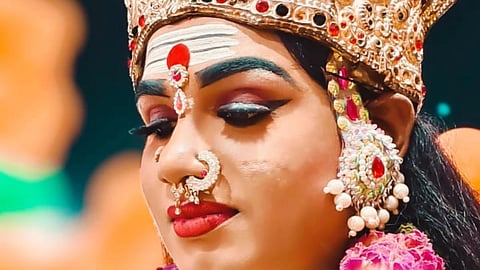

The alarm goes off at 3.30 am. Shamala wakes up instantly. Once ready, she makes a hurried check of costumes, jewellery, makeup kits, wigs, and crowns — all packed into a bag weighing over 10 kg — and rushes out. There is almost no time for breakfast. By dawn, she is on a bus, surrendered to routine, watching the first light of day spread across as she travels to a temple festival, or a cultural programme. In just 20 minutes, this trans woman would transform into a folk artiste, a performer, or a goddess.
The backstage rush is almost ritualistic for Shamala. Makeup is layered, heavy costumes are fastened, ornate jewellery is adjusted, flowers are woven into hair, and an imposing crown is placed on her head carefully. For the next few hours, she is Goddess Kali, Mariamman, Angalamman, or another revered deity, who dances with abandon, while devotees often fold their hands before her in reverence.
After the performance, leaving her divine form on stage, she boards another bus home. What she carries back with her are applause and contentment — that has her returning to the stage for the past 22 years.
For Shamala, this is more than just an act. “It is a livelihood, an identity, and the art that fed me, gave me dignity, and made me who I am,” she says.
Where it all began
After losing her father at a young age, financial hardship forced her into work early. “There was nobody to look after us. I started working as a domestic help when I was about 12 years old,” Shamala recalls. In the later years, she moved to Kerala, where she spent four to five years doing odd jobs before returning to her native, Cuddalore, in 2004.
Back home, stable employment remained elusive. She worked odd jobs, until a friend, Rudhra, introduced her to local cultural programmes. Dance had always been cathartic for her. “Whenever songs played on television, I would dance along,” she says. Her interest caught the attention of a Karagattam performer who portrayed goddesses during temple festivals. Recognising her talent, he encouraged her to step into the role herself.
Shamala’s mother opposed the idea, yet she persisted. Her first performance brought home just Rs 50, despite spending nearly Rs 400 on costumes, accessories, and makeup. “It took me almost a year to earn Rs 1,000 per programme. It wasn’t much, but I continued as I believed this was my path,” she says.
This art has helped me pay bills. I’ve never had to beg or depend on anyone for survival. Wherever I go today, people recognise me and show me respect.
Shamala
Art’s choice
Over 20 years, she has trained nearly 30 students from the community in choreography, makeup techniques, costumes, and stagecraft. Many have gone on to become performers. “I feel proud that I’ve been able to pass on our folk traditions,” she notes.
Her contributions have also earned her several honours over the years , including a doctorate, the Puducherry Government’s Kala Ratna Award, the Majestic Art Award, the Sangamam Award, and the Outstanding Transgender Dancer Award. She has performed across the country, but one milestone remains close to her heart. “Being selected for Chennai Sangamam last year changed everything,” she says. “It brought me the recognition that opened many more doors for me and the people from my community.”

Those doors, however, were not always easy to unlock. “I actively kept approaching government departments and organisers. I submitted applications to councillors and ministers, wherever I could because I felt if one of us entered these spaces, many others would follow,” Shamala says.
Though audiences now celebrate her performances, the prejudices around it have not disappeared. Shamala voices a dark side of her profession where there is often no safety. “Some men touch me inappropriately, pass vulgar comments, use slurs and abuse me. It happens almost every day, at almost every event,” she admits. The irony is that it is happening in temples where the deities reside, to someone who is embodying one. Even though Shamala refuses to let those moments overshadow her successes, she notes that silence is the price she pays.
But it is the very art that makes devotees bow before her. They see divinity in her presence, making her forget her empty stomach, sleepless days and nights, and the exhaustion after each performance. That is acceptance. That is victory. That is home for Shamala.
NOTE: If you or a colleague has faced any form of workplace abuse, please file a complaint with the IC under POSH. Every individual, regardless of their gender identity, is entitled to a safe work environment.