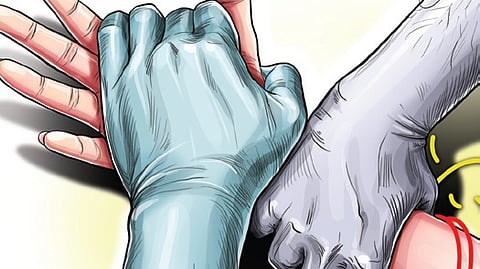

The Delhi High Court has overturned the acquittal of a man who sexually harassed his teenage neighbour in 2013. He had been cleared of all charges the following year, through a trial in which the complainant’s apparel and character had been attacked during cross-examination. The High Court has not only overturned the acquittal, but has also rubbished the justification for the previous verdict. Justice Sudha Chandrasekaran’s statement is clear: “The suggestion that a woman wearing jeans may ‘corrupt young boys’ reflects a deeply troubling and unacceptable mindset.”
One of the salient points of the judgement is that rather than only focus on the perpetrator, the culture of misogyny is itself held accountable. The High Court’s statement went on to say: “Parents and society must instead [of policing women’s apparel] teach their children to control their conduct.”
“Children” in this instance clearly indicates boys, and tasks parents with the responsibility of not passing down misogynistic ideas or letting their sons get a free pass when they absorb these ideas from elsewhere. This is a welcome reversal to the way in which the upbringing of a girl or a woman is questioned as part of slut-shaming following a violation. The onus in all cases of misbehaviour is on the perpetrator, and if it is to extend anywhere else, it must only be on those who shaped the individual.
Sexual predation exists on a spectrum: from word and gaze to cybercrime to physicality. So does rape; we are fortunate to have a broad legal definition of rape in India at present, because of legal amendments made following the landmark “Nirbhaya” crime in 2012.
That expanded definition has helped many survivors who have sought legal recourse, including in another case that has recently had a re-reckoning. Editor Tarun Tejpal was acquitted of the charge of raping a young colleague in 2021, eight years after the incident. The Goa bench of the Mumbai High Court has overturned the ruling and convicted him this month.
As with the survivor in the sexual harassment case overturned by the Delhi High Court, the survivor in this case also underwent extreme character assassination and gossip, both in-court and on public forums, some of which has been exhumed again.
Between 2013 and 2026, when both these cases occurred, enough has changed for the better in the public imagination about consent and autonomy that the contemplation of how hard it was at the time to name, let alone testify about and pursue justice for, such violation is a heavy one. How much must it have taken a dozen years ago to do this, before the MeToo movement offered empowering language and healing framings? How much it still takes, and will always take, to have to do this. The bravery of both plaintiffs – a teenager, and a woman who was subordinate to a powerful man — is evident.
While the outcome of these cases — at least as they stand today, subject to further appeals — is heartening, these victories come after long fights, and failures, both linked to the expectation that what absolves a criminal is less rigorous than the standards by which survivors should behave.
