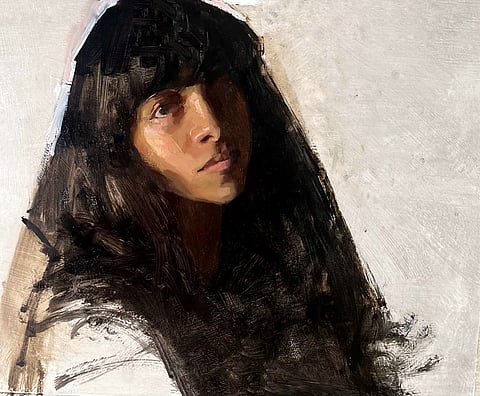

There is a metaphoric bond between portraits and the perplexities we humans experience. An ambivalent mind, an aching heart, a body and its spurts of joy, a slump of illness, a strong sweeping death. And between all these junctures, our lives are marred with minuscule moments. Years ago, the Mexican artist Frida Kahlo mastered the art of preserving these fragments of moments she survived. She poured the raw colours of miscarriage, birth, spinal operation, and her own inner conflicts onto her canvas. Her artistic style of never distancing herself from her canvas, depicting pain with resilience, has struck a chord with many. Decades later, women still create their own style of portraits, where they don’t feel the need to put a veil on the vulnerability of the body or the mind. If Frida Kahlo were alive today, she would probably feel the grip of solidarity — the collective idea of creating a self-paved visual identity — very strongly.
Women artists share their intimate relationship with colours, canvas, cameras, and themselves and how they have been witnessing their lives through self-portrait paintings and photographs.

For Bindya TS, a self-portrait artist, art has shadowed her through thick and thin since she was a child. “I was always insecure about my body and my abstract thoughts. But as a kid, I was told abstract thoughts don’t have meaning.” While she couldn’t shun her thoughts, all Bindya wanted was a home for her wild thoughts. “No one told me art is subjective. But as I started to discover this art of self-portraiture, it helped me understand the most intriguing and intricate self of mine. I realised that I could weave poetry through my own body.”
In an overwhelmingly humungous, cold world, art is like a hearth of safety for Bindya, where she can look reality in the eye. “Every time I do self-portraits, I create my own reality that the world doesn’t know. The sense of safety comes through it.” Bindya’s photographs capture unfeigned versions of herself — her brown skin, the resolute look she wears, the scars on her body, the tattoos on her bare chest and arms. “I never knew how carrying the scars and brown skin was such a powerful feeling until I explored this art.”
Bindya’s fondness for abstract, neo-noir cinema, and cult classics has seeped into artworks. A recurrent shade in many of her self-portrait photographs is red; she says, “it makes me get over my insecurities, embraces the feminine energy through elegance, boldness and most importantly, empowers my creative thought process.”
Moments of happiness and hysteria — her art has seen it all. A series of photographs called ‘Emotions’ was a documentation of one of the darkest phases of her life. She wails, screams in pain, stares in silence. She says, “I actually cried my heart out. It felt like an absolute relief from the heavy feeling that I was facing for a long while.” In hindsight, she says, “I’ve documented myself in my vulnerable state, and I have also felt there’s always light at the end of the tunnel.” For Bindya, finding the similarities between nature and humans also became an important journey of self-exploration through photographs.
Initially, the intention of photography for Irene*, a self-taught artist, was just to get good portraits. She says, “It later became a tool to know myself; it became a ritual to sit in front of the camera at least once a month and pose.” After she has played with palettes on her eyelids and lips, she sits in front of the camera. She wanders around her room with her camera clutched tight whenever she feels low. She then captures the little joys of reading a poem or singing a song. “That becomes a way of letting go of disturbing thoughts.” These photographs of her personal moments are often not saved or uploaded anywhere. She says, “It’s just an act of archiving myself in the moment. Maybe trying to let my brain know that I am trying.”
Painting at different stages of life, for Akshaya Parthasarathy, is not a reflection of her growth trajectory but of her own self. She brings in the perspective of an arts student: “As the student matures, self-portraits start to become much more than an exercise.” Today, this process has become a session where she can let go of any inhibitions. “Self-portraits were a way to experiment without the pressure of failure”. Akshaya tries to break off the “dark and moody environment” she has been replicating on the canvas. In her self-portrait named ‘Green frog’, which features a frog, she tries to deviate from the stagnancy by “shifting the palette”. She says, “It allowed me to divert into a new approach to painting.” Her artworks, she says, have “unintentionally become documentations of my life”.
Artist Jitha Karthikeyan believes her work is a “reflection of the intellectual, social, and emotional geographies I inhabit”. Self-portraits, for her, make the transience of time, identity, and existence a tangible experience. She says, “For an artist, looking back at earlier self-portraits may indeed be a revelation, especially when one has travelled quite far from some of the earlier versions of oneself.” As someone who has closely watched and questioned her innate self, she portrays herself most authentically. “My artworks well up from within me. They are expressions of the thoughts and experiences that have consumed me.”
Her painting, ’Where Would Our Roots Rest If Not in Land?’, carries the grief that stemmed from the loss of her ancestral home. “In many ways, it was my final farewell to the tangible place from which I come.” ‘Erasure and Beyond’ was an attempt to deal with the unpleasant reality of death: “to find the loved ones’ presence in abstract forms”. “I began with a cherished childhood memory, painting it in meticulous detail, before gradually distorting the figures of those who had passed away. Erasing the physical forms of people who had once been part of my everyday life was an intensely painful process.”
She recounts a phase when she was navigating an emotional crisis, and art was the only way to give her spiralling thoughts a space of solace. “A self-portrait in the form of the Trojan horse kept appearing in my subconscious. It became necessary to give the horse a voice because mythology has largely celebrated the human victory in the Trojan War, while the horse remained nothing more than a silent vehicle for human ambition. At that point in my life, I found myself identifying with the horse — present, burdened, and voiceless.”
For Hemalatha Venkataraman, a senior UX strategist and artist, the longing to stay connected to her roots intensified when she moved abroad. A series of annual ‘Self Portraits in a Saree’ was her way of “capturing a piece of past along with new present”. She adds, “Being in a foreign country, it felt all the more important to bring myself to sarees, with a collection I was then building.” One such series was about documenting her in her late paternal grandmother’s saree.
For Dr Abhinaya Karunanidhi, a dermatology resident and an artist, her steps into sketching and photography were quite instinctive. Her first self-portrait, she recalls, was a reflection of what she saw in the mirror — a girl with teary eyes and a broken heart. For her, self-portraits depend on the version that feels to be celebrated: “leisure self, curious self, maniac self, sad self, low in confidence self, doubtful self, angry self…whatever wants to come out that day.”
She speaks about the time snatched away by trauma. “I’ve even forgotten a year of my life.” But what didn’t wither away was what she had sketched then. “I only remember whatever I drew on paper, and most of them were self-portraits.” She talks about a portrait, drawing an analogy with spilt milk. “It (the self-portrait) was a short comparison with milk that spills when unwatched. I was spilt for 26 years, and it was time I cleaned off the stove. The photograph felt like the documentation of self-love and acceptance, taken with flowers I found in a vase and a freshly coloured wall in my brother’s room.”
The medium of expression might differ; the tones and emotions may vary — but there is something universal, yet extremely personal about self-portraiture. It’s the rich inner world of the past that they can access at any point in time. As Abhinaya, who has been painting since she was a kid, says, “I haven’t stopped witnessing my life just like Frida Kahlo did.”
*Name changed