
CHENNAI: S Ramesh (name changed) bought a 2,400 sqft plot a year ago in TNHB’s Sholinganallur Phase III layout, survey number 235, after paying nearly Rs 1 crore for it. The layout has everything in place – roads, metrowater, stormwater drains. SBI approved his housing loan, and since then, the 52-year-old central government employee has been paying an EMI of Rs 1.8 lakh a month.
“Today, I am not able to build a house in the plot. The Greater Chennai Corporation is not issuing building permission as the plot falls within the 1-km zone of influence around the Pallikaranai Ramsar site. I cannot even sell the land as buyers have disappeared, leaving me to service a massive loan for a property I cannot use,” he told TNIE.
Ramesh is just one among the more than 1 lakh patta holders in Chennai’s southern suburbs hit by a planning freeze around the Pallikaranai Ramsar site, according to the Confederation of Real Estate Developers’ Associations of India (CREDAI) - Chennai, which puts the economic impact at nearly Rs 71,500 crore.
The freeze traces back to an October 2025 order from the Chennai Metropolitan Development Authority (CMDA), barring planning approvals within the Ramsar site’s boundary and the 1-km zone of influence around it, following directions from the southern bench of the NGT. The residents say several houses across the affected belt are now half-built, after banks withdrew from releasing loan instalments since approvals are uncertain.

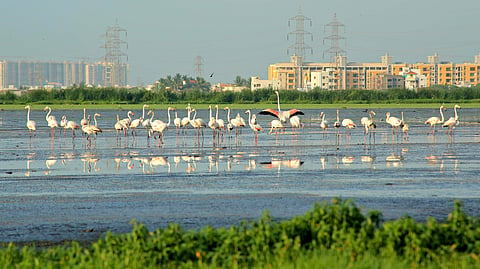
Pallikaranai, declared a Ramsar site in 2022, is Chennai’s last major freshwater wetland. It drains a 250 sqkm catchment, absorbs floodwater, recharges groundwater and filters pollutants. The Integrated Management Plan drawn up by Care Earth Trust ahead of the Ramsar tag calls it critical natural infrastructure and warns that letting it degrade further would come at a real ecological and economic cost.
CREDAI argues the blanket freeze has swallowed legally sanctioned residential layouts and patta land well outside the marsh’s actual extent.
“The additional 550 hectares, apart from 698 hectares of Pallikaranai swamp reserve forest, included when the Ramsar site was declared in 2022 have not yet been scientifically demarcated on the ground, creating uncertainty over which survey numbers actually form part of the wetland,” said Mehul H Doshi, president, CREDAI Chennai.
The Tamil Nadu State Wetland Authority said the process is already in motion.
“The Ramsar boundary and the final notified wetland boundary are not the same. The boundary has to undergo ground-truthing, survey-number verification, stakeholder consultation and notification before it is finalised,” said Srinivas R Reddy, member secretary of the authority.
Reddy added the revenue department is handling the delineation, and only once statutory notification goes through can the National Centre for Sustainable Coastal Management (NCSCM) map the zone of influence and draw up the final Integrated Management Plan. “The whole process will take time,” he told TNIE.
At NCSCM, Purvaja Ramachandran, Scientist-G and Division Chair, said her agency is still waiting on the final wetland boundary from the State Wetland Authority.
The NGT itself had noted that CMDA required the final survey numbers, boundary details and development guidelines from the Wetland Authority before incorporating them into the Master Plan. Until then, the planning freeze continues.
For thousands of land owners like Ramesh, the legal and scientific process has translated into a financial crisis. While the government works towards scientifically defining the wetland and protecting one of Chennai’s most valuable ecosystems, homebuyers say they remain caught in an uncertainty where EMIs continue every month, but the homes they planned to build remain out of reach.
Meanwhile, CREDAI has moved the Madras high court challenging the CMDA ban order. The case is coming up for hearing on July 10.