
Quite far from the heart of the city, at Perungalathur, around three decades back, most of the houses had gardens. Some grew flowers like hibiscus and jasmine, while others cultivated drumsticks and papaya. There was a family-like harmony between the neighbours. There was a tradition of exchanging harvest. Overtaken by nostalgia, fashion designer Ashwin Thiyagarajan takes us through his childhood. “My mom used to hand-make garlands with the flowers from the garden. The fragrance, the humble nature of life, and diverse families coexisting beautifully — it’s etched in my memory.” This shows up in his work, his very own label Ashwin Thiyagarajan, even in the latest bridal wear, Alar. “I don’t go looking for inspiration; the inspiration is inside me. I have lived it,” says Ashwin.
The 36-year-old designer gave up his room to set up a small atelier in 2015 and began making clothes while still working in IT. He grew up in Santhome and Mylapore predominantly and is now settled in Thiruvanmiyur. He is in the city after a three-year sabbatical in Goa with “renewed energy and an evolved perspective on everything.”

Excerpts from CE’s interaction with the designer about Alar:
Could you take us to your first sketch of the collection?
It’s funny that you asked me about the first sketch. My label partner Nishanth still wonders how this collection came to life because he didn’t see the sketches. Truth is, there were none. I sketched them in my mind and brought them to life. While explaining to my team, I made rough sketches but this was one collection that didn’t have precise sketches. One of my favourite things to do is close my eyes and design in my head. If you could have a look at that database of sketches, you’ll see that I have only realised 8-10% of the designs that I want to make.
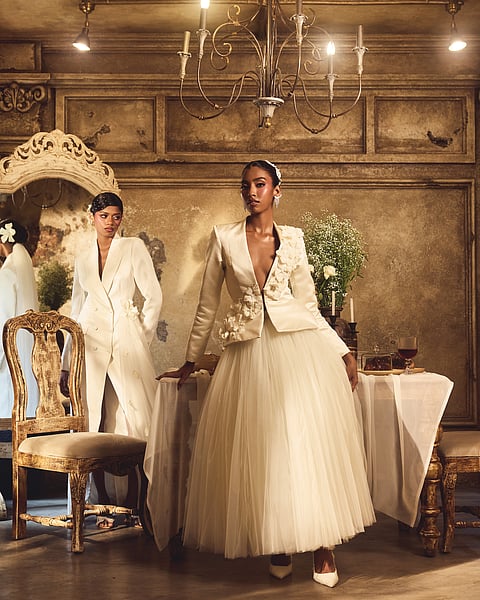
As Tamilians, we are very diverse. There are many faiths and religions. Each carries its own traditions. As soon as I moved back to Chennai from Goa, the first four custom outfits I was working on were all Christian wedding gowns. That made me understand that there is a gap in that market. Alar was created to address that gap. Hence, we went with all white.
Alar brings together corsets and structured tailoring with Tamil bridal traditions. How did you decide what to preserve from tradition and what to reinterpret?
It’s an instinct-based decision for me. I rely heavily on my instincts. There is an unspoken, invisible symbiosis I believe I have with the market. It aids me in choosing the right direction for the brand and hence the market. It comes from deeply listening to the clients I meet, not just to the words spoken out loud. It gives me a thorough understanding of what people want from me.
Bridal fashion has often reflected ideas of caste, class, and gender. As a designer, how do you engage with these histories while creating something contemporary? What, to you, makes Alar distinctly Tamil?
I revere history. I celebrate culture. It is only natural that it influences my work. When I’m designing, I’m always thinking about who I’m designing for. Who is going to wear it? How would they want to feel in it? How can I make sure I see a twinkle in their eyes when they wear it? While history is great, I also want to make sure I package it and present it right so a bride of today would desire to wear it. The motifs I chose and the way I presented the collection I think are undeniably Tamil, in my eyes.
Is there a detail in Alar that a Tamil bride would recognise immediately, but someone unfamiliar with Tamil culture might overlook?
It is the hibiscus flowers. They were everywhere when I was growing up and in so many colours. It’s all bougainvillea now. But I believe it used to be sembaruthi that held that place for a while. To someone unfamiliar with this, it might look like just a floral motif. Tamil brides understand what the flower means and represents. It grew in everyone’s garden, immaterial of religion, caste, gender.
What does a typical day in your studio look like? When you find yourself creatively stuck, what helps you move forward? How has learning Kathak influenced your approach to design?
A typical day is: I go to the atelier, meet my staff. I have a hardworking team behind me who really make the backbone of my brand. We discuss order pipeline, collection work, see samples, plan shoots etc. I check the garments in progress, make changes if required, make everyone understand the day’s tasks and then I step aside to sit with my own tasks for the day. Creatively stuck is fortunately a feeling that I have never felt. I have been creatively overwhelmed though when too many ideas and too many collections are happening all at once. That’s why I have found ways to ground myself.
Kathak being one and Hindustani music being another; it helps me get out of my head and stay in my body. The one hour of dancing or singing, helps me improve my focus, increase my attention span and overall assists in keeping my mind fresh. These practices are for the joy they bring me, they are not connected to my design. But the joy they bring me helps me become a better human and hence a better designer.
What do you think are the biggest shortcomings in the bridal fashion industry today? What change would you like to see?
The number of replicas from which many brands make money out of is shocking. Customers don’t care because it comes at a much cheaper price. Designers in Chennai have stolen my work and sold it as their own. It’s quite unpleasant. I think brands need to work with integrity and customers need to be conscious of the choices they make. That’s a change I would like to see. And now with AI taking over, clients have started coming to us with AI sketches. I really want that to stop. Sadly, I’m not hopeful.
What advice would you give young designers who hope to build work that is original, culturally rooted, and socially conscious?
Where you are from is your absolute strength. Because you know the nuances of your culture like no one else does. Taking inspiration from what you know in your blood and bones is a recipe for success. Bring who you are to the work you do every chance you get. It may not be everyone’s cup of tea but you will develop a following that will truly resonate with the work you put out.
Which look in Alar feels the most personal to you, and why?
Every garment is challenging to make. For every look, before working with the actual fabric, we make samples in muslin/kora fabric to get the silhouette right. Sometimes we create 3-4 samples just to nail the shapes and structure. It is a tedious but gratifying process.
The look that feels the most personal is the first one. A corset featuring flowers, some hidden inside sheer fabric and some on top like embellishments, and an asymmetrical ball gown skirt. It is the first ever sketch I had made in my mind. The cherry on top was the hairband veil we had created for this look.
Can you describe the first time someone wore a piece from Alar? How do you know when a design is truly finished?
Models Nisha and Nandana had come in for a fitting — absolutely stunning beauties. Nisha wore the first piece during our fitting and I had chills. At that very moment, the design I sketched in my head had come to life exactly the way I had imagined it. I felt grateful for many things. For the team that helped me, for the model who was the perfect muse but more than all my absolute perseverance to bring what was just a sketch in my head to reality without compromising any details. I had stopped giving myself pats on the back but I realised it is something that I need to do.
What are you working on next? Finally, what is the biggest misconception people have about fashion designers?
I have just launched two collections. One was Alar, the other was a festive collection featuring organic cotton and block print. There is time for the next big collection. I can assure you that the next one will be a moment in my career.
The biggest misconception about fashion designers. I have been told by some people that I come off as unapproachable. But I think it really is just the outrageous clothing choices we make. Beyond and underneath all the labels we carry, we are just beings of love much like everyone else.