
Why do traditional game boards around the world repeatedly use the same geometric patterns? Imagine finding a board scratched onto a temple floor in India and finding it repeated across the world in Spain or Africa or South America.
The materials are different. The people are different. Yet again and again the same shapes appear. A cross, a circle, a square divided into smaller squares or a star. Why?
Perhaps it is because most traditional board games begin not with game pieces but with a pattern. The board determines movement, possibilities, restrictions and interactions. Without a board, there is no game. We do not always know why a board was designed in a particular way. We do not know what inspired it. Yet it is difficult to ignore the fact that the same geometric patterns appear throughout human life and across cultures.
Perhaps our ancestors who designed the games simply borrowed shapes already familiar to everyday life. But why did these shapes feel familiar? The ancient Greek philosopher Plato described five perfect geometric forms that later became known as the platonic solids. Built from simple and repeating shapes, these solids fascinated philosophers, mathematicians, and artists because they seemed to reveal an underlying order in nature.
We see squares in fields and city plans. Triangles bring stability to structures. Circles appear in wheels, gathering spaces and celestial bodies. Grids help us organise everything from maps to spreadsheets. Perhaps it was this universality of certain shapes that inspired our ancestors who designed these games. It seems that people were naturally drawn to certain patterns when creating systems of movement and play.
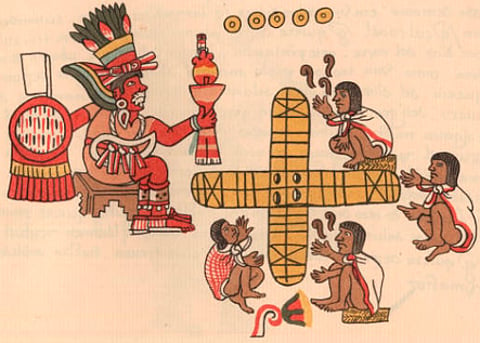
This could be why game boards from different cultures can feel strangely familiar. Take the game of Chaupad or Daayakattam on a symmetric cross. Compare it with a game called Patolli, played centuries ago in Mesoamerica by the people of present-day Mexico. There were no historical links between the makers of Patolli and the creators of Indian games like Chaupad. Oceans separated them. Languages separated them. Entire civilisations separated them.
Yet, the boards look strangely similar and at their heart was a cross. The games did not have the same rules or the same cultural context. Yet, the resemblance was impossible to ignore. This is one of numerous other games where similarities can be traced across the world.
A traditional game board may look like nothing more than a few lines scratched on stone or earth. Yet, those lines are remarkably persistent. Across centuries and cultures, people have repeatedly chosen the same handful of geometric forms to organise play. They continue to appear because they are more than designs. They are among humanity’s simplest ways of understanding space itself.
And in their simplicity they survived. Not because they were written down but because they were easy to remember. In a world where the oral tradition thrived, these shapes stayed with us bringing us a wide variety of traditional games and a quiet link to our cultural past all human civilisation.
