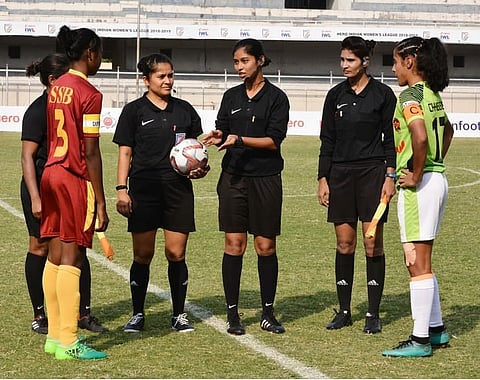

With just minutes left on the clock, two teams that have dedicated every moment for a chance at the World Cup, tensions and aggression running high, the referee has one job — keep things going smoothly. FIFA 2026 has given fans plenty of iconic moments. One among them was the match between Czechia and South Africa, refereed by an all-women team (for the second time in FIFA history). For Harsha Saini (27), one of Karnataka’s first national-level referees, the moment was an inspiring one. “It made me feel so motivated to see how well they handled the game. Especially in a male-dominated field, with 22 players and a huge crowd, whatever decision you make, half the stadium will be happy and the other half will be disappointed. The pressure is intense, but having been in similar situations at a much smaller level, it also gives you courage.”
Among the handful of national-level women referees, Harsha as well as Neha M (29), another AIFF National Referee, started off their careers as footballers playing at the collegiate, club and state levels. Refereeing came as a suggestion from their coaches and became something they fell in love with. “I like being a leader and when I became a referee, it gave me the feeling that the field is mine,” shares Neha, adding, “I also had a meniscus injury so this was a way for me to stay connected with football.”
For Jancymary (31), a referee from Tamil Nadu who also coaches young footballers, stepping onto the field was intimidating because there were so few women around. She credits her coach, Sarathy, for creating an environment where women felt safe enough to stay in the sport. “He would ask the senior boys to look after the girls who came to play. Because of that, we felt safe. Even then, we were scared. We were afraid to step onto the ground,” she recalls. This hesitation did not disappear overnight. “The biggest challenge was confidence. At first, I was worried that people would shout at me. The officials gave me many men’s matches to officiate, and that experience helped me overcome my fear,” she says. Today, alongside officiating local matches on the path to national assignments, Jancymary coaches around 10 children while continuing her athletics training, hoping more women will see refereeing as a viable career.
While they were already used to the fitness expectations of being players, refereeing brought specialised training and challenges, requiring yearly exams of fitness and theory to keep advancing in the eight-level qualification system. “Our drills are based on game requirements – sometimes, you have to just stand and watch, sometimes jog, sometimes sprint towards an incident. So, we prepare ourselves for flexibility and mobility to move from one place to the other — running sideways, backwards and sprinting,” shares Harsha. To qualify as a referee for different levels of the sport — women’s games, men’s games and for FIFA, the running speeds and other fitness qualifications, vary.
Despite the positive attention on FIFA’s women referees, though, among the 170 officials for the World Cup: 52 centre referees, 88 assistant referees and 30 video assistant referee (VAR) officials, only six are women. Women’s participation in refereeing is low, notes Neha, attributing it to a lack of awareness. “Until I started training, I did not know that it was possible to be a woman referee,” she says, adding, “We need more investment, mentoring and training but for that to happen, more women need to come out and express their interest.” In Tamil Nadu, Rupa Devi became the first woman referee from Tamil Nadu to be selected by FIFA in 2016. Jancymary shares that women like Rupa are great inspiration for her.
While fans at home have their eyes on the ball and the players, Harsha has half her attention on the ref, constantly noticing and learning — after all, every referee’s dream is the FIFA world cup and so is hers. “In every situation, I try and take the decision before they can and then analyse the calls, how they are reacting, and running,” she says. “I’ve experienced this at a tiny level but I imagine myself experiencing this on a big stage, hopefully someday I end up there,” she concludes.
