
When authors try to weave multiple political, social, and economic struggles into a work of fiction, often it can feel like tokenism. Like an exercise in ticking boxes to appear relevant or politically conscious.
Now, consider this cast of characters and ideas: an upper-caste, wealthy Marxist; a Tamil lowered caste woman; Eelam Tamils who turned to militant organisations in their struggle for justice; the Indian manosphere; Artificial Intelligence deployed as a tool for oppressing women; and a misogynistic, right-wing network of online hitmen. On paper, it sounds like a political kichadi — an unwieldy mix of issues and identities.
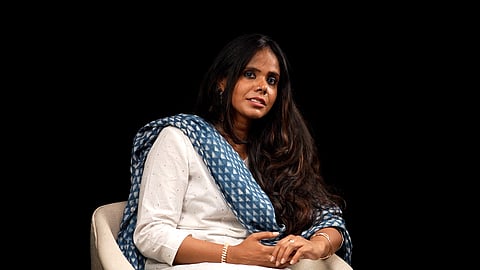
Yet somehow, Meena Kandasamy makes it work in her latest book, Fieldwork as a Sex Object (HarperCollins). The story feels less like a checklist of contemporary concerns. Instead, each character and political thread emerges organically from the story, making the novel feel deeply considered and not performative. Rather than simply representing different struggles, the book opens up difficult political questions and invites the reader to sit with their complexities.
Excerpts follow:
What was the first spark or idea that led you to write this book?
I think the first trigger was possibly the Pollachi incident (a case of rape and extortion of various women by a group of men who befriended the women online, took them to isolated places, sexually assaulted them and taped the act to use it against them for additional sexual favours or money). But, I also realised that technology today has evolved and anything can be morphed. So, deepfakes, I think, is another ticking time bomb for women. I wanted to write about it especially because the concept of shame and the way it is attached to women is very different from the way it is attached to men. The internet goes all out against women, especially if they’re political and outspoken. They call women all kinds of names. And we’ve all seen that with the evolution of Twitter (X) and Facebook. But I think once (deepfake) images and videos came, it did not stop at name calling. I just wanted to chronicle that.
Was any part of writing this book particularly challenging for you?
I think all of it was challenging. One of the reasons why I like to do fiction is also because I want to be challenged. I had questions like, ‘How do I write this person?’; ‘How do I choose?’; ‘How is she going to be?’; ‘Should she be likable?’ Another question was, ‘Do you write a contemporary novel? And if you’re doing that, do you think the book will last 50 years? Will it be relatable?’
When I thought about it, I realised that what we think of as modern, recent, and cutting edge, it’s all going to be a graveyard. So, I wanted to chronicle the internet, not just as the most hyper-present space or the futuristic space, but as a space that is designed and primed to become a digital graveyard.
The book is filled with internet slang and platform-specific language that can risk dating the novel in a decade. Did you see that as a literary risk or was preserving the texture of this time more important?
I think it’s very difficult to speak about the internet without using the language of the internet. Otherwise it will look like someone who has no clue is writing about it. The internet lingo also changes so fast. But for me, it was about capturing this particular moment where all of these anxieties are playing out for all of us.

The protagonist Amy’s inner conflicts never disappear beneath the weight of larger political questions that the novel raises. What did it take, as a writer, to hold those tensions together?
It was about grappling with some questions. One of the questions is something I often ask myself, ‘Will you extend solidarity to someone you don’t like?’ ‘What if they are annoying?’ ‘What if they are provocative?’ Solidarity cannot be conditioned, because it comes out of political understanding. The second question within me was, how far does somebody have to go and prove they are genuine. Especially in the era of cancel culture, you say one wrong thing and people cancel you. The third question was also how much privilege can save you?
But from the outside, I wanted to look quite closely at the left itself, because I think that the left has a lot of very good political standpoints — we are against capitalism, corporates, we don’t like big tech, we are against surveillance. But when it comes to sexuality, the left is, I think, as bad as the right. What I really felt, especially with leftist student politics and smaller left groups is that they are so obsessed with going into people’s sexuality, going into people’s morality.
What was your thought process behind writing a maternal figure who carries her own contradictions because of internalising patriarchy while also trying to, in her own way, break free from it?
I think the older women are always invisible. They disappear out of fiction. I think the readers like young people because a young person is a sex object, can be sexualised, can be modified, can be consumed. Here, I couldn’t put an older woman at the heart of a sex tape because it was so much about sexuality. But the fact is, I wanted a very strong woman there; a conflicted woman.
Also, one of the things I understand is the idea of the Indian mother. We always think of Indian mothers and how they love their sons. But, do we write about the mother who actually wants her daughter to be free? I think there are so many mothers who don’t want us to get into traps that they know exist out there, and I think they’re watching out for us.
The conversation between Amy and the white professor about fascism…was it inspired by a specific real-life exchange, or did it emerge from your own reflections on contemporary fascism over time?
I generally observed that there is a certain formula with which the West looks at these things. Like they really want to turn everything into a science — LHS=RHS, everything is within parentheses and there’s a square root, and genocide is what happens to white people. They wouldn’t say for instance, what happened to Tamils in Sri Lanka as genocide.
Holocaust is like a very specific word for a very specific historical event. Anything else happens anywhere else, the West won’t give that word to it. And the same thing happens also to the word fascism. If it happens in Europe, it’s fascism, but if it happens elsewhere, they cannot be called fascists and the West finds excuses to justify it. And I’m like, well, “you know, you don’t get to decide”.
In the Indian context, how should we think about the relationship between individual misogyny and the broader social conditions that sustain the Indian manosphere?
A lot of men (Indian) are not incels in the technical Western way. And the Indian manosphere, unlike other places in the world, is for hire. So they would suddenly start bashing Palestine because they’re like troll farms and they would, you know, push certain agendas on, let’s say, state autonomy, or language rights, or whatever. So, you pay them, they do it. They are also somewhat politically organised, and often they follow a very corporate model. But it’s not organic. And the minute we understand it’s not organic, we can understand that this can be dismantled; that it is money that fuels and sustains the system.
With individual misogyny, meanwhile, I think there can be a course correction. A lot of men who are individual misogynists change when their daughter gets abused, goes through violence. They’re like, ‘Oh, let’s take a look at the system.’
But in terms of understanding misogyny individually along with the system, that brings out the hate against women. How many hate crimes have we seen? Individual instances like revenge porn happen; there’s also this collective witch hunt that goes on towards outspoken women, they are putting Muslim women for auction, they are leaking new naked photos of well-known activists. These kinds of things are a result of a collective and that makes them inflict harm.